





Revision rhinoplasty often requires additional cartilage to restore nasal support, correct structural problems, or improve breathing after a previous nose surgery. When the remaining septal cartilage is insufficient, surgeons may consider cartilage grafts taken from the patient’s ear or rib.
Both options play important roles in nasal reconstruction, but they differ in strength, flexibility, available quantity, and surgical applications. Ear cartilage is often suitable for selected tip, nostril, and contour corrections, while rib cartilage can provide stronger structural support for more complex revision procedures.
Understanding the differences between ear and rib cartilage grafts can help patients make informed decisions about revision rhinoplasty in Turkey. This guide explores their uses, advantages, limitations, potential complications, and recovery expectations.
In rib cartilage graft rhinoplasty, cartilage is harvested from the costal cartilage of the chest wall.
A small incision is made over the selected rib cartilage. The required amount is removed while the surgeon takes care to protect the surrounding tissues.
Rib cartilage is particularly valuable because it can provide a larger volume of strong graft material. The rib cage offers a substantial cartilage reserve that can be shaped into different grafts for complex nasal reconstruction.
Characteristics of Rib Cartilage
Rib cartilage is generally:
- Strong
- Abundant
- Suitable for long grafts
- Capable of providing major structural support
- Useful when multiple grafts are required
- Carvable into different shapes and thicknesses
These characteristics make rib cartilage especially useful when a nose has lost significant structural support.
When Is Rib Cartilage Used?
Rib cartilage may be considered for:
- Major dorsal reconstruction
- Severe saddle-nose deformity
- Septal extension grafts
- Significant nasal lengthening
- Major tip-support reconstruction
- Multiple spreader grafts
- Reconstruction after several previous operations
- Severely contracted noses
- Large structural defects
- Cases with very limited septal and ear cartilage
- Revision surgery requiring several grafts
A complex cartilage graft revision nose job may require both strong support and enough material to rebuild several regions of the nose. Rib cartilage can provide this reserve.
Advantages of Rib Cartilage
Greater Quantity
The rib usually provides substantially more material than the septum or ear.
This is particularly important when several grafts must be created during the same operation.
Strong Structural Support
Rib cartilage may be used to reinforce a weak bridge, stabilise the tip or resist scar-tissue contraction.
Suitable for Long and Straight Grafts
Carefully carved rib cartilage can be used for longer structural components that would be difficult to create from naturally curved ear cartilage.
Useful in Multiple-Revision Cases
Patients who have undergone several operations may have little usable nasal or ear cartilage remaining. Rib cartilage may provide the material required for major reconstruction.
Versatility
The surgeon can carve rib cartilage into different graft types, including structural and contouring grafts.
Limitations and Risks of Rib Cartilage
Rib cartilage also has specific considerations.
Warping
Warping means that carved cartilage gradually changes shape.
Because rib cartilage has internal tension, a graft can bend after carving if those forces are not balanced. Surgeons use various carving and stabilisation techniques to reduce this risk.
A meta-analysis of autologous rib cartilage in rhinoplasty identified warping as one of the more notable graft-related complications, although overall long-term complication and donor-site morbidity rates were low.
A later meta-analysis involving 1,648 patients reported pooled rates of approximately 3.05% for warping, 1.2% for resorption, 1.45% for infection and 1.53% for contour irregularity. Study designs and surgical techniques varied, so these figures should not be treated as a personal prediction of risk.
Chest Scar
Rib harvesting creates a separate chest incision.
The final scar may vary according to:
- Incision size
- Skin type
- Scar tendency
- Wound tension
- Postoperative care
- Previous chest surgery
- Individual healing response
Hypertrophic or raised scarring is possible, particularly in patients prone to thick scars.
Donor-Site Discomfort
Patients may feel pain, pressure or tightness around the chest incision.
Discomfort may be more noticeable when:
- Coughing
- Laughing
- Taking a deep breath
- Turning in bed
- Lifting objects
- Using the upper body
The intensity and duration vary between patients.
Pleural Injury or Pneumothorax
The pleura and lung lie beneath the chest wall. Injury is uncommon but is a recognised risk of rib cartilage harvesting.
A systematic review reported low pooled rates of pneumothorax and pleural injury across published studies. These risks depend partly on surgical technique and patient anatomy.
Longer or More Complex Surgery
Rib harvesting adds another surgical area and may increase operating time.
Rib Cartilage Donor-Site Recovery
During early donor-site recovery, patients may experience:
- Chest tenderness
- Tightness
- Bruising
- Swelling
- Temporary numbness
- Discomfort during movement
- Sensitivity around the incision
- Mild discomfort with deep breathing
Patients should follow instructions regarding wound care, activity and medication.
Heavy lifting, intense upper-body exercise and movements that place tension on the incision may be restricted temporarily.
Increasing redness, discharge, fever, severe shortness of breath, sudden chest pain or rapidly increasing swelling should be reported immediately.
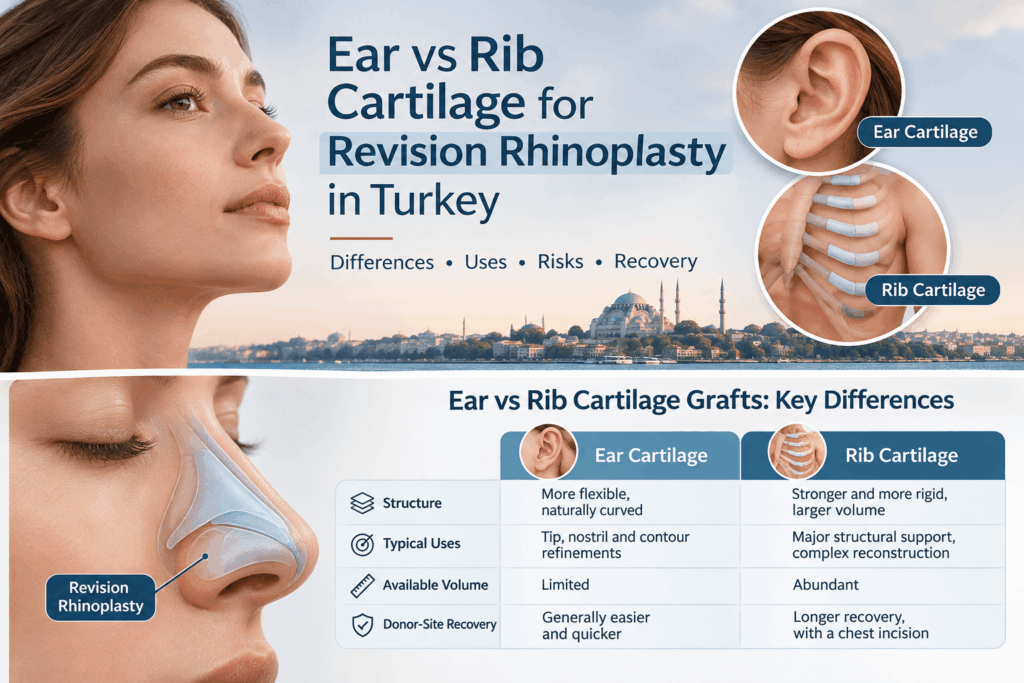
Ear vs Rib Cartilage: The Main Differences
The most important differences can be summarised as follows.
Quantity
Ear cartilage: Provides a limited or moderate amount.
Rib cartilage: Provides a larger reserve for extensive reconstruction.
Strength
Ear cartilage: Flexible and suitable for softer support or contouring.
Rib cartilage: Stronger and more suitable for major structural rebuilding.
Shape
Ear cartilage: Naturally curved.
Rib cartilage: Can provide longer and straighter grafts after careful carving.
Typical Uses
Ear cartilage: Often considered for alar, tip, contour and selected valve grafts.
Rib cartilage: Often considered for dorsal reconstruction, nasal lengthening, major tip support and multi-graft revision cases.
Donor Site
Ear cartilage: Usually harvested through an incision around or behind the ear.
Rib cartilage: Harvested through a chest-wall incision.
Recovery
Ear cartilage: May cause temporary tenderness and discomfort when sleeping on the operated side.
Rib cartilage: May cause chest discomfort during movement, coughing or deep breathing.
Specific Concerns
Ear cartilage: Limited volume and natural curvature.
Rib cartilage: Warping, chest scarring and uncommon chest-wall complications.
Is Ear Cartilage Safer Than Rib Cartilage?
It is not accurate to say that one donor site is universally safer or better.
The risks are different, and the appropriate choice depends on the planned reconstruction.
A prospective donor-site study found that patient-reported pain did not always match the common assumption that rib harvesting causes substantially greater discomfort than ear harvesting.
The more important question is whether the selected cartilage can provide the required support.
Using ear cartilage for a reconstruction that requires strong, long grafts may produce insufficient support. Using rib cartilage for a small contour correction may introduce more donor-site surgery than necessary.
Can Ear and Rib Cartilage Be Used Together?
Yes. In complex cases, the surgeon may use different cartilage sources for different purposes.
For example:
- Rib cartilage may provide the main structural framework.
- Ear cartilage may be used for curved alar reconstruction.
- Remaining septal cartilage may be used for a small, straight graft.
- Soft tissue or fascia may be added for camouflage.
The material should be matched to the anatomical task.
How Does the Surgeon Choose the Graft Source?
The decision may depend on:
- The number of previous operations
- The amount of remaining septal cartilage
- The severity of structural damage
- Skin thickness
- Scar-tissue contracture
- Nasal bridge support
- Tip stability
- Nasal valve function
- The number and type of grafts required
- Ear shape and available conchal cartilage
- Chest anatomy
- Previous donor-site surgery
- The patient’s scar history
- Functional and aesthetic goals
An online assessment can help identify the likely complexity, but the final graft plan may change after physical examination or during surgery.
Previous surgical reports can be useful because they may indicate whether septal, ear or rib cartilage was already harvested.
Recovery After a Cartilage Graft Revision Nose Job
Recovery involves both the nose and the donor site.
The nose may remain swollen and firm for longer than after primary rhinoplasty because revision surgery involves scarred tissues and structural reconstruction.
Patients may temporarily experience:
- Nasal congestion
- Tip swelling
- Bridge swelling
- Bruising
- Numbness
- Firmness
- Temporary asymmetry
- Reduced definition
- Donor-site discomfort
The grafted nose continues changing as swelling decreases and scar tissue matures. Final refinement may require a year or longer.
Patients should avoid smoking and nicotine, protect the nose from trauma and follow all instructions regarding medication, cleaning, taping and activity.
Choosing Revision Rhinoplasty in Turkey
Patients considering revision rhinoplasty in Turkey should choose a surgeon who can explain not only where cartilage may be taken from, but why that material is suitable for the specific reconstruction.
Useful questions include:
- Is there enough septal cartilage left?
- Which areas of my nose need structural support?
- Would ear cartilage be strong enough?
- Why might rib cartilage be necessary?
- How many grafts are expected?
- Where will the donor-site incision be placed?
- What donor-site scar should I expect?
- How is rib-cartilage warping reduced?
- Could the graft be visible beneath my skin?
- How will follow-up be managed after I return home?
The final decision should be based on nasal anatomy rather than selecting the donor site only because one option sounds less invasive.
Frequently Asked Questions
Is ear cartilage strong enough for revision rhinoplasty?
It may be strong enough for selected alar, tip, contour and valve grafts. It may not provide adequate rigidity for major bridge or length reconstruction.
Does taking ear cartilage change the shape of the ear?
The surgeon aims to preserve the visible ear shape. However, contour change, asymmetry and scarring are possible donor-site risks.
Does rib cartilage grow back?
The harvested cartilage should not be expected to regenerate in a way that restores the original donor site. The surgeon removes only the amount required while preserving chest-wall stability.
Is rib cartilage painful?
Chest tenderness and tightness can occur. Pain varies, and research suggests donor-site discomfort may be less severe than many patients expect.
Can rib cartilage warp years later?
Warping may occur as the graft’s internal forces change its shape. Careful selection, balanced carving and fixation are used to reduce the risk.
Which cartilage is better for a nasal bridge?
Rib cartilage may be more suitable when major bridge reconstruction requires substantial, strong material. The correct choice depends on the size of the defect and available septal cartilage.
Which cartilage is better for nostril reconstruction?
Ear cartilage is often useful because of its natural curvature, but the selected technique depends on the severity and location of the problem.
Can both ears provide cartilage?
Both ears may be potential donor sites, but this is not required or appropriate for every patient.
Will I know the graft source before surgery?
The expected source should be discussed before surgery. However, the final decision may depend on the amount and quality of cartilage found during the operation.
Final Thoughts
Ear and rib cartilage are both valuable materials in revision rhinoplasty, but they serve different purposes.
Ear cartilage is naturally curved, flexible and useful for many alar, tip and contour grafts. It may be suitable when a moderate amount of material is required.
Rib cartilage provides greater volume and strength. It may be preferred for extensive reconstruction, nasal lengthening, major bridge support or cases involving a significant septal cartilage shortage.
The most suitable graft is not necessarily the option with the smallest incision. It is the material capable of providing stable support while balancing nasal shape, function and donor-site risk.
For patients considering revision rhinoplasty in Turkey, the graft source should be selected only after a detailed evaluation of the remaining nasal framework, scar tissue, airway and previous surgical history.
To discuss ear cartilage graft rhinoplasty, rib cartilage graft rhinoplasty or a complex cartilage graft revision nose job, contact Dr. Cem Altındağ’s team for an individual assessment.
This article is intended for general educational purposes. It does not replace a physical examination, diagnosis or personalised medical advice from a qualified physician.
