





Cartilage grafting is one of the most important parts of many revision rhinoplasty procedures. During a previous operation, the natural nasal framework may have been reduced, weakened or repositioned. Some patients also have insufficient septal cartilage because it was removed during an earlier rhinoplasty or septoplasty.
When the remaining nasal cartilage cannot provide enough material, the surgeon may consider cartilage from another part of the patient’s body. The ear and rib are two commonly discussed donor sites.
For patients considering revision rhinoplasty in Turkey, the choice between ear and rib cartilage is not simply a matter of personal preference. Each material has different characteristics. Ear cartilage is naturally curved and relatively flexible, while rib cartilage can provide a larger volume and stronger structural support.
This guide compares ear and rib cartilage grafts, explains their typical uses and discusses what patients may expect from donor-site recovery.
Why Is Cartilage Needed in Revision Rhinoplasty?
The nose depends on a framework of cartilage and bone for its shape and function.
During primary rhinoplasty, cartilage may be trimmed, divided or repositioned to refine the tip, reduce a hump or correct asymmetry. If too much tissue is removed or the remaining structures lose support, the nose may gradually develop aesthetic or functional problems.
Cartilage grafts may be needed to:
- Rebuild a weakened nasal bridge
- Strengthen a drooping or unstable tip
- Correct nasal valve collapse
- Improve breathing
- Restore missing projection
- Correct retracted nostrils
- Camouflage contour irregularities
- Lengthen a shortened nose
- Support a deviated septum
- Reconstruct damage caused by previous surgery
Revision rhinoplasty frequently requires grafting because the surgeon is working with altered anatomy and may need to replace support that is no longer present.
Dr. Cem Altındağ’s revision rhinoplasty information explains that ear cartilage may be used when septal cartilage is insufficient, while rib cartilage may be considered in complex cases requiring a larger amount of graft material.
What Is a Septal Cartilage Shortage?
The nasal septum is the internal wall separating the right and left nasal passages. Part of it consists of cartilage that can be used to create grafts.
Septal cartilage is often preferred because it is:
- Located in the same surgical area
- Usually straight
- Relatively firm
- Suitable for many structural grafts
- Available without creating a separate external donor site
However, the surgeon must leave enough septal cartilage to maintain nasal support.
A septal cartilage shortage may occur when:
- Cartilage was removed during the first rhinoplasty
- The patient previously underwent septoplasty
- The remaining septum is weak or deformed
- The nose requires more graft material than the septum can provide
- Previous surgery damaged the available cartilage
- Several structural grafts are required
When the septum cannot safely provide enough material, the ear or rib may become the next option.
What Is Ear Cartilage Graft Rhinoplasty?
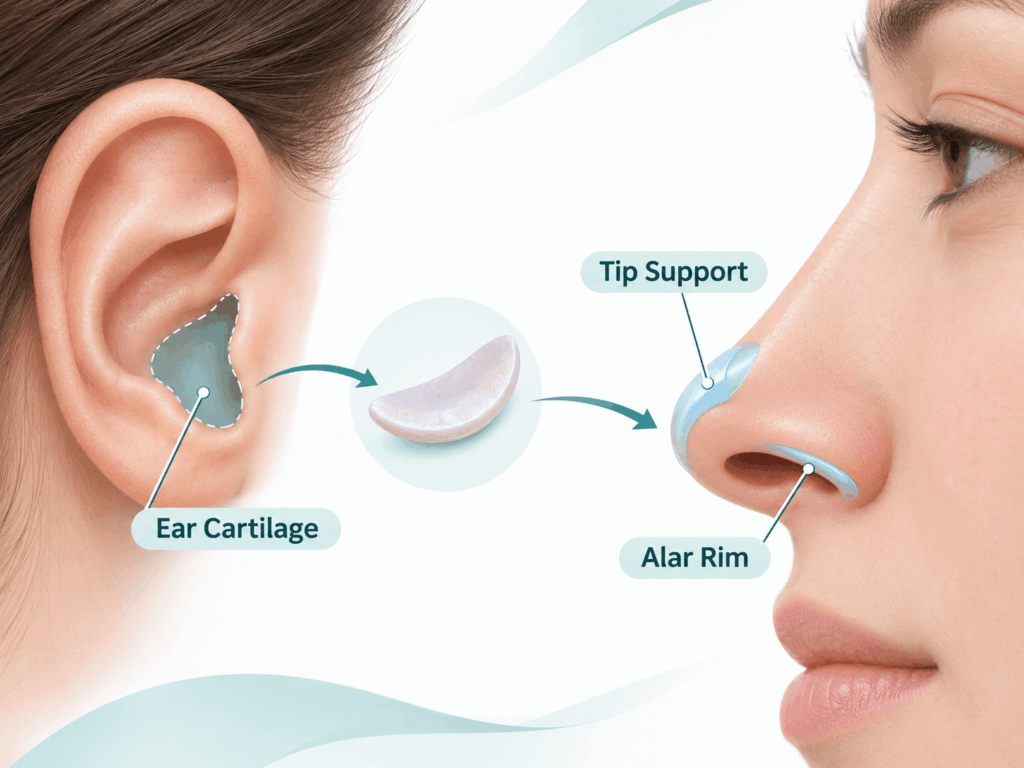
In ear cartilage graft rhinoplasty, cartilage is usually taken from the conchal bowl, the curved central part of the external ear.
The incision is commonly positioned behind the ear or within a natural fold. The surgeon aims to remove the required cartilage while preserving the visible shape and support of the ear.
Ear cartilage is biologically compatible because it comes from the patient’s own body. Research on patients undergoing septorhinoplasty has described auricular cartilage as an accessible alternative when septal cartilage is deficient.
Characteristics of Ear Cartilage
Ear cartilage has several useful features.
It is generally:
- Naturally curved
- Relatively flexible
- Easy to shape for selected grafts
- Suitable for softer contour reconstruction
- Available through a relatively small donor-site incision
Its natural curvature can be beneficial when reconstructing rounded or curved areas of the nose. However, it may be less suitable when a long, perfectly straight and highly rigid graft is required.
When Is Ear Cartilage Used?
Ear cartilage may be considered for:
- Alar rim grafts
- Alar contour grafts
- Selected tip grafts
- Shield grafts
- Batten grafts
- Camouflage grafts
- Minor bridge irregularities
- Nostril support
- Selected external nasal valve problems
- Soft-tissue contour refinement
It can be especially useful in the lower third of the nose, where a degree of natural curvature may help recreate the shape of the nostrils or nasal tip.
An ear graft can also be divided, layered or shaped according to the area being reconstructed.
Advantages of Ear Cartilage
Potential advantages include:
A Convenient Source for Moderate Grafting
Ear cartilage may provide enough material when the revision requires one or several relatively small grafts.
Natural Curvature
The conchal cartilage’s curved shape may be helpful for reconstructing the alar region and selected tip structures.
No Chest Incision
Harvesting ear cartilage avoids an additional incision on the chest.
Generally Limited Donor-Site Changes
When cartilage is harvested carefully, the surgeon aims to preserve the external appearance and structural stability of the ear.
Studies examining patient-reported outcomes after auricular cartilage harvesting have generally found low levels of concern about donor-site appearance and function.
Useful for Camouflage
Ear cartilage can be softened, crushed or shaped for selected contour irregularities when strong structural support is not the main requirement.
Limitations of Ear Cartilage
Ear cartilage is not suitable for every revision.
Possible limitations include:
- Limited quantity
- Natural curvature
- Less rigidity than rib cartilage
- Difficulty producing long, straight grafts
- Insufficient strength for major bridge reconstruction
- Limited ability to support a severely contracted or collapsed nose
A patient requiring several strong grafts may not have enough usable material in one ear. Harvesting from both ears may be possible in selected cases, but this must be weighed against donor-site considerations.
Ear cartilage may be appropriate for a localised correction but insufficient for a nose that requires extensive structural rebuilding.
Ear Cartilage Donor-Site Recovery
After ear cartilage harvesting, patients may experience:
- Tenderness
- Swelling
- Bruising
- Temporary numbness
- A feeling of tightness
- Discomfort when sleeping on the operated side
- Sensitivity around the incision
The incision is often positioned so that it is not easily visible from the front.
Patients may be advised to avoid pressure on the ear during early recovery. Glasses, headphones, sleeping position and hair care may require temporary adjustment.
A prospective study comparing auricular and costal donor sites found that patients did not necessarily experience greater donor-site pain than nasal surgical pain. The findings also challenged the assumption that rib harvesting is always associated with severe postoperative discomfort.
Although significant deformity is uncommon with careful harvesting, possible ear donor-site risks include:
- Bleeding
- Infection
- Haematoma
- Visible scarring
- Contour change
- Prolonged numbness
- Asymmetry
- Tenderness
The surgeon should explain where the incision will be placed and how much cartilage is expected to be removed.
