





Yes, it is usually possible to have a Turkey nose job after septoplasty. However, a previous septum operation can change how the new procedure must be evaluated and planned.
Septoplasty is generally performed to straighten the internal nasal septum and improve airflow. Rhinoplasty changes the external shape of the nose, while functional septorhinoplasty may address both appearance and breathing. Although these procedures have different primary goals, they work on structures that are closely connected.
During septoplasty, cartilage may have been removed, reshaped, scored, repositioned or used as a graft. Internal scar tissue may also have formed. As a result, a patient seeking rhinoplasty after septoplasty may have less septal cartilage available and a different internal anatomy from someone who has never undergone nasal surgery.
This does not mean that rhinoplasty is unsafe or impossible. It means the surgeon needs more information before deciding which techniques and graft materials may be required.
Quick Answer: Can Rhinoplasty Be Performed After Septoplasty?
A cosmetic or functional rhinoplasty can generally be performed after septoplasty when:
- The septum and surrounding tissues have healed
- The nasal shape and breathing are stable
- There is no active infection
- The skin and internal lining are healthy
- The remaining cartilage can provide adequate support, or another graft source is available
- The patient’s expectations are realistic
- The surgeon understands what was changed during the previous procedure
The operation may remain relatively straightforward when the first septoplasty was limited and healed well. It can become more complex when a large amount of cartilage was removed, breathing problems continue, the septum has become unstable or the external nose changed after surgery.
The most important question is therefore not only, “Can I have a nose job after septoplasty?” It is, “What structures remain, what problems need correction and how can the nose be reshaped without weakening its function?”
Septoplasty, Rhinoplasty and Septorhinoplasty: What Is the Difference?
Understanding these terms can make the treatment plan easier to follow.
Septoplasty
Septoplasty focuses primarily on the nasal septum, the internal wall dividing the right and left nasal passages.
Its goals may include:
- Improving airflow
- Correcting a deviated septum
- Removing obstructive cartilage or bone
- Repositioning bent septal structures
- Treating selected internal contact points
- Creating better access to other intranasal areas
A standard septoplasty does not usually aim to change the external appearance of the nose. However, the septum is also a central support structure. Significant changes to it can sometimes influence the bridge, tip or overall stability.
Rhinoplasty
Rhinoplasty reshapes the external nose.
It may address:
- A dorsal hump
- A wide or crooked bridge
- A drooping or over-rotated tip
- A bulbous tip
- Excessive projection
- Nostril asymmetry
- A long or short nose
- Facial imbalance
Even when rhinoplasty is requested for cosmetic reasons, the internal airway should still be examined. The American Academy of Otolaryngology–Head and Neck Surgery recommends evaluating rhinoplasty candidates for nasal airway obstruction during preoperative assessment.
Septorhinoplasty
Septorhinoplasty combines external nasal reshaping with functional surgery involving the septum, nasal valves or other airway structures.
A patient who continues to have a deviated septum or breathing difficulty after septoplasty may need a functional septorhinoplasty rather than a cosmetic-only procedure.
A combined treatment plan may address shape and breathing during the same operation.
Does Previous Septoplasty Make Rhinoplasty a Revision Operation?
This question does not always have a simple answer.
If a patient has undergone septoplasty but has never had cosmetic nasal surgery, the planned procedure may technically be their first rhinoplasty. However, the surgeon is still operating on a previously treated septum.
From a planning perspective, the nose may therefore share some characteristics with revision surgery:
- Internal scar tissue may be present
- Septal cartilage may be limited
- The original anatomical planes may have changed
- The septum may contain previous incisions or weakened areas
- Internal support may need reconstruction
- The breathing problem may not have been fully corrected
For this reason, previous septoplasty rhinoplasty should not automatically be planned like an untouched primary nose.
The complexity depends on what was done during the septoplasty—not simply on the fact that an operation occurred.
How Can Septoplasty Change the Anatomy of the Nose?
The septum is not only an internal divider. It also contributes to the structural support of the nasal bridge and tip.
During septoplasty, the surgeon generally corrects the deviated portions while preserving enough cartilage to maintain stability. A supporting section of cartilage, commonly described as an L-shaped strut, is usually left along the upper and front borders of the septum.
The exact technique varies according to the deviation and the surgeon’s approach.
After septoplasty, the nose may have:
- A strong and stable remaining septum
- Adequate cartilage available for future grafting
- Limited remaining septal cartilage
- Areas of weakened or scored cartilage
- Internal scar adhesions
- Persistent deviation
- A small septal perforation
- Changes in tip or bridge support
- Previously placed cartilage grafts
A prior septoplasty may leave limited autologous septal cartilage for a later rhinoplasty, especially when a significant amount was removed during the first operation.
Four Common Scenarios After Septoplasty
The treatment plan often falls into one of four broad categories.
1. Breathing Is Good and the Septum Is Stable
Some patients have a successful septoplasty and later decide that they want cosmetic changes.
They may request:
- Hump reduction
- Tip refinement
- Bridge narrowing
- Correction of external asymmetry
- Changes in projection or rotation
If the septum is stable and enough cartilage remains, the procedure may be planned similarly to primary rhinoplasty, with additional awareness of the previous internal surgery.
2. Breathing Problems Continue After Septoplasty
Persistent obstruction may occur even when the septum looks straighter.
Possible causes include:
- Residual septal deviation
- Nasal valve narrowing
- Dynamic sidewall collapse
- Turbinate enlargement
- Internal scar adhesions
- Caudal septal deviation
- Dorsal septal deviation
- Allergic or inflammatory nasal disease
- A combination of structural and mucosal problems
A recent study of patients seeking rhinoplasty after septoplasty found that all included patients reported persistent nasal obstruction, while more than half had an external nasal deformity on examination. This does not mean every septoplasty patient will have these problems; it illustrates the importance of reassessing both the airway and external framework when symptoms continue.
In this scenario, a cosmetic-only operation may not be sufficient. Functional reconstruction may be required.
3. The External Nose Changed After Septoplasty
Septoplasty does not usually cause major visible changes when support is preserved. However, structural complications can occur.
Potential changes include:
- Tip drooping
- Reduced tip support
- A lower bridge
- Saddle-nose deformity
- Worsening external deviation
- Columellar retraction
- A wider or flatter appearance
- New asymmetry
These problems may indicate that the septal framework needs rebuilding rather than further reduction.
4. There Is a Septal Perforation or Significant Scar Tissue
A septal perforation is an opening in the septum.
Symptoms may include:
- Whistling
- Crusting
- Dryness
- Recurrent bleeding
- Nasal obstruction
- An unstable feeling
- No symptoms at all
Small, asymptomatic perforations may not always require repair. Larger or symptomatic defects can make rhinoplasty more complex because the septum may provide less stable support.
Combined septal perforation repair and rhinoplasty can be performed in selected patients, but it is considered technically demanding and requires careful evaluation of the remaining tissue and blood supply.
Is There Enough Septal Cartilage for the New Nose Job?
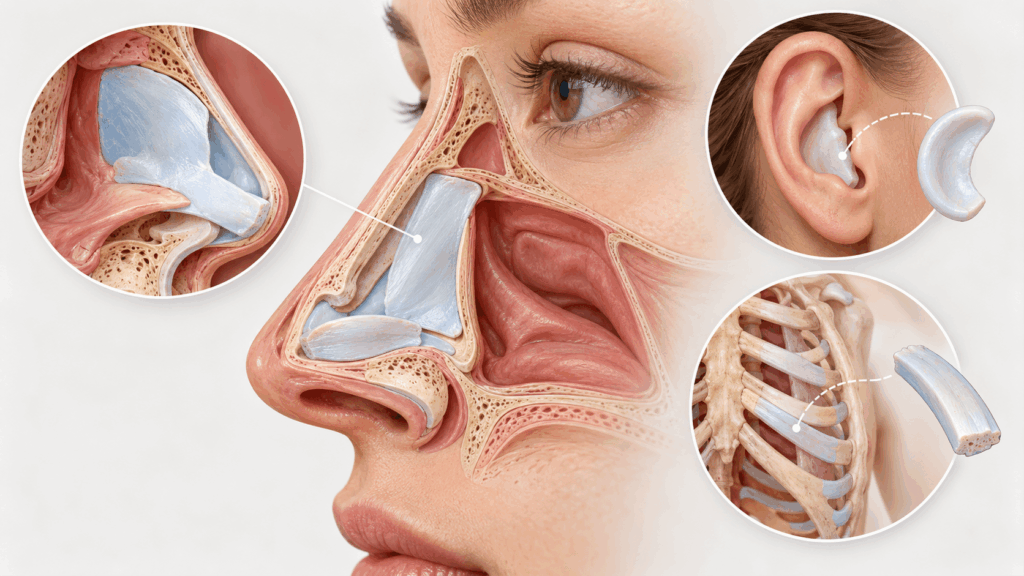
This is one of the most important questions in rhinoplasty after septoplasty.
Septal cartilage is frequently preferred for grafting because it is usually:
- Straight
- Firm
- Located in the same surgical field
- Suitable for structural grafts
- Available without an additional ear or chest incision
However, the surgeon must preserve the cartilage needed to support the septum.
The amount remaining after previous surgery cannot always be confirmed through photographs or patient memory.
Possible methods of evaluation include:
- Reviewing the previous operative report
- Physical examination
- Nasal endoscopy
- Assessing septal firmness and support
- Reviewing previous imaging when medically relevant
- Direct inspection during surgery
Ultrasound has also been studied as a method of identifying remaining septal cartilage after previous septoplasty, but it is not a universal or routine requirement for every patient.
What Happens When Septal Cartilage Is Insufficient?
A shortage of septal cartilage does not automatically prevent rhinoplasty.
The surgeon may consider other sources.
Ear Cartilage
Ear cartilage may be useful for:
- Alar rim grafts
- Nostril support
- Selected tip grafts
- Camouflage
- External nasal valve support
- Smaller structural corrections
It is naturally curved and more flexible than rib cartilage.
Rib Cartilage
Rib cartilage may be considered when:
- A larger quantity is required
- The bridge needs major reconstruction
- Strong tip support is necessary
- The nose is shortened or contracted
- Several grafts are required
- Both septal and ear cartilage are insufficient
Existing Cartilage Grafts
If cartilage was placed during the previous procedure, it may sometimes be preserved, repositioned or reshaped.
However, an old graft may be unsuitable if it is:
- Warped
- Displaced
- Damaged
- Infected
- Too small
- Unstable
- Surrounded by dense scar tissue
The final graft decision may sometimes be made only after direct surgical examination.
Which Nasal Surgery Records Should You Provide?
Patients planning a Turkey nose job after septoplasty should collect as many relevant records as possible.
The most useful nasal surgery records include:
Previous Operative Report
This is often the most valuable document.
It may explain:
- Which parts of the septum were removed
- Whether an L-strut was preserved
- Whether the caudal septum was repositioned
- Whether spreader grafts were placed
- Whether turbinate surgery was performed
- Whether ear or rib cartilage was harvested
- Whether a perforation or complication occurred
- Which suture or implant materials were used
Discharge Summary
The discharge report may contain the diagnosis, procedure name, medications and early postoperative findings.
Preoperative and Postoperative Photographs
Images can help the new surgeon understand:
- The original nasal shape
- Changes caused by surgery
- Whether the external deviation existed before septoplasty
- Whether tip support or bridge height changed
- How the nose evolved during healing
Useful photographs include front, side, three-quarter and base views.
Previous CT or Imaging Reports
A CT scan is not routinely required simply because a patient wants rhinoplasty after septoplasty.
Research indicates that preoperative CT imaging is not generally supported as a routine part of septal-deviation assessment. It is more commonly used selectively when symptoms or examination suggest sinus disease, polyps, complex internal anatomy or another condition requiring imaging.
Patients should still bring existing scans and reports rather than repeating them unnecessarily.
Endoscopy Reports
Previous nasal endoscopy findings may identify:
- Residual deviation
- Adhesions
- Perforation
- Turbinate enlargement
- Internal valve narrowing
- Inflammation
- Other intranasal problems
Details of Previous Complications
The new surgical team should know about:
- Infection
- Heavy bleeding
- Delayed healing
- Septal haematoma
- Perforation
- Loss of smell
- Skin problems
- Anaesthesia complications
- Persistent numbness
- Previous emergency treatment
Even when no written report is available, the patient should describe what happened as accurately as possible.
What If You Cannot Obtain the Operative Report?
Many international patients cannot access records from an operation performed years earlier.
This does not necessarily prevent surgery.
The surgeon may still gather useful information through:
- Detailed medical history
- External examination
- Intranasal examination
- Endoscopy
- Breathing assessment
- Palpation of the septum and tip
- Existing photographs
- Examination of donor-site scars
- Selective imaging when indicated
However, the surgical plan may need to remain flexible.
For example, the surgeon may explain before surgery that septal cartilage will be used if enough remains, but ear or rib cartilage may be necessary if the septal reserve is inadequate.
How Is Breathing Evaluated Before the Operation?
A patient who previously had septoplasty should not assume that a straight-looking septum guarantees normal airflow.
Nasal obstruction can occur at several levels:
- The septum
- Internal nasal valve
- External nasal valve
- Turbinates
- Nasal sidewalls
- Tip-support structures
- Nasal lining
- Nasopharynx
An advanced preoperative assessment may include:
- Comparing airflow through each nostril
- Internal examination
- Nasal endoscopy
- Observing sidewall movement during inhalation
- Assessing the internal and external valves
- Examining the caudal septum
- Evaluating turbinate size
- Reviewing allergy and sinus symptoms
- Recording how obstruction changes with activity or sleep
The NOSE questionnaire or another validated symptom scale may be used to establish a baseline and measure functional change after surgery.
A review of nasal airway evaluation emphasises that obstruction may arise from the septum, nasal valves, turbinates, mucosa or nasopharynx. Treatment should therefore target the actual level of obstruction rather than assuming every symptom is caused by the septum.
