





There is no single operation that corrects every elevated nostril rim.
The selected technique depends on the severity of the retraction, the amount of missing support and whether there is enough skin and internal lining to move the nostril downward.
Alar Rim Graft
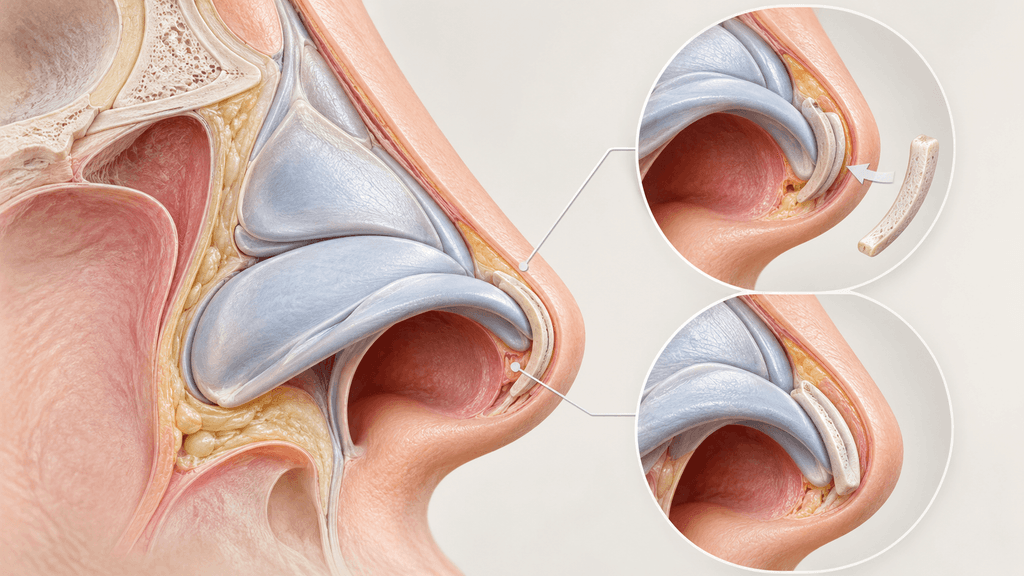
An alar rim graft, sometimes called an alar contour graft, is a thin piece of cartilage positioned along the nostril margin.
Its purpose is to:
- Support a weak alar rim
- Smooth an irregular nostril contour
- Reduce mild retraction
- Improve nostril symmetry
- Strengthen the external nasal valve
- Prevent future collapse
The graft is usually placed in a carefully created pocket close to and parallel with the alar rim.
An alar rim graft may be appropriate for mild or moderate problems when the soft tissue can be repositioned without significant tension. It may not provide enough downward movement in severe retraction or when skin is missing.
Articulated Alar Rim Graft
An articulated alar rim graft is connected to or supported by the existing lateral cartilage.
This creates a more integrated structural relationship between the nasal tip framework and the nostril margin. It can provide support while helping shape the curve of the ala.
Recent clinical research has described articulated rim graft techniques, sometimes combined with soft-tissue advancement, as an option for improving alar retraction while maintaining a natural nostril contour.
Lateral Crural Strut Graft
A lateral crural strut graft is positioned beneath the existing lower lateral cartilage.
It may be used when the cartilage is weak, curved incorrectly or positioned too high. The graft can strengthen and reposition the lateral crus, which may improve both nostril shape and sidewall support.
This technique treats the structural source of the deformity rather than only adding material beneath the visible rim.
Lateral Crural Extension Graft
A lateral crural extension graft may be used when the existing cartilage is too short or does not extend far enough toward the nostril margin.
The graft extends the structural framework and helps move the alar rim downward.
Published surgical reports indicate that lateral crural extension grafting can be useful for selected cases, while severe skin deficiency may require more extensive reconstruction with a composite graft.
Cartilage Repositioning
If enough lower lateral cartilage remains, the surgeon may release it from scar tissue and move it into a more favourable position.
Cartilage repositioning may be combined with sutures, an alar rim graft or a structural strut graft.
Reusing the patient’s remaining cartilage can be helpful, but previously operated cartilage may be weakened, uneven or insufficient.
Composite Ear Graft
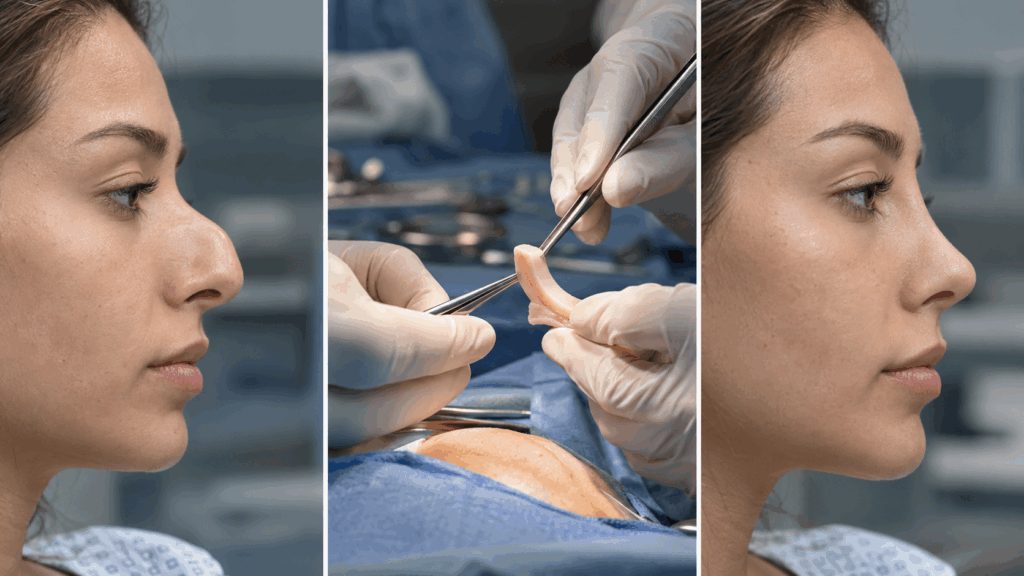
A composite graft contains both cartilage and skin, usually taken from the ear.
It may be considered when the patient has a shortage of both structural support and soft tissue. The skin portion helps replace missing nasal lining or rim tissue, while the cartilage supports the nostril margin.
Composite grafts are generally used for more significant retraction or tissue loss. Their size and placement must be carefully planned because the graft needs an adequate blood supply to survive.
The ear donor area is selected so that any change in its contour is kept as limited as possible.
Tip Repositioning
When excessive upward tip rotation contributes to the problem, the treatment plan may include lowering or lengthening the tip.
Correcting only the alar rim without addressing an over-rotated tip may leave excessive nostril visibility.
Tip repositioning may require:
- Structural sutures
- Septal extension grafting
- Columellar support
- Tip grafts
- Reconstruction of the lower lateral cartilages
The goal is to restore balance between the tip, nostrils and columella.
Where Does the Cartilage Come From?
Revision rhinoplasty often requires additional cartilage because material from the nasal septum may have been removed during the first operation.
Possible cartilage sources include:
Septal Cartilage
Remaining septal cartilage may be used when enough is available and removing it will not weaken nasal support.
Ear Cartilage
Ear cartilage has a natural curve that can be useful for alar reconstruction. It is commonly considered for alar rim grafts and composite grafts.
Rib Cartilage
Rib cartilage provides a larger and stronger supply of graft material. It may be considered in extensive reconstruction or when several parts of the nose require support.
The selected source depends on the size, strength and shape of graft required. The American Society of Plastic Surgeons notes that revision rhinoplasty often requires ear or rib cartilage when septal cartilage is insufficient.
Can Nostril Show Correction Improve Breathing?
It may improve breathing when alar retraction is associated with external nasal valve weakness or collapse.
Supporting the nostril margin can help prevent the sidewall from moving inward during inhalation. However, breathing problems may also involve the septum, internal nasal valve, turbinate tissue or other structures.
A complete nostril show correction plan should not assume that every breathing problem comes from the visible alar rim.
Functional examination may include:
- Internal nasal examination
- Assessment during normal and deep breathing
- Evaluation of sidewall collapse
- Septal assessment
- Comparison of airflow on both sides
Aesthetic and functional treatment can sometimes be performed during the same revision procedure.
Recovery After Alar Retraction Surgery
Recovery depends on the extent of reconstruction.
A limited alar rim graft procedure may involve less swelling than a complete revision rhinoplasty. More extensive surgery involving tip repositioning, cartilage grafting or composite tissue reconstruction can require a longer recovery.
Patients may experience:
- Swelling
- Bruising
- Nasal congestion
- Temporary numbness
- Firmness around the nostrils
- Mild early asymmetry
- Tenderness at the cartilage donor area
- Changes in nostril shape during healing
The nostril rims may initially look lower, uneven or swollen. Scar tissue can also change the appearance during the first months.
Patients should avoid pulling, pressing or repeatedly checking the nostrils. Postoperative taping, cleaning and medication should be used exactly as instructed.
Increasing redness, severe pain, discharge, fever, skin-colour changes or worsening breathing should be reported promptly.
Risks and Limitations
All surgery carries risks, and revision rhinoplasty is less predictable than primary rhinoplasty because the tissues have already been altered.
Possible risks include:
- Bleeding
- Infection
- Prolonged swelling
- Persistent asymmetry
- Visible or palpable graft edges
- Graft movement
- Scar-tissue recurrence
- Partial loss of correction
- Continued breathing problems
- Donor-site discomfort
- The need for another procedure
Perfect nostril symmetry cannot be guaranteed. Natural nostrils are rarely identical, and scar tissue may affect each side differently.
The realistic goal of alar retraction correction is to improve support, reduce excessive nostril exposure and create a more balanced relationship between the tip, alae and columella.
Choosing Revision Rhinoplasty in Turkey
International patients considering revision rhinoplasty in Turkey should focus on the surgeon’s experience with structural and reconstructive nasal surgery.
A surgeon who performs primary rhinoplasty may not necessarily handle complex alar reconstruction regularly.
Patients should ask:
- What is causing my alar retraction?
- Is the problem cartilage, scar tissue or missing skin?
- Which graft technique may be needed?
- Is there enough septal cartilage left?
- Could ear or rib cartilage be required?
- Will the nasal tip also need repositioning?
- Can the procedure improve my breathing?
- How long should I remain in Istanbul?
- How will follow-up be managed after I return home?
- What limitations should I realistically expect?
Before-and-after photographs should ideally include front, side, three-quarter and base views. Fully healed results are more informative than photographs taken only a few weeks after surgery.
Dr. Cem Altındağ’s Istanbul practice provides functional and aesthetic nasal surgery, including revision procedures for patients who have previously undergone rhinoplasty. A
preliminary international assessment may include photographs, breathing concerns and details of the patient’s previous operations.
Frequently Asked Questions
Can alar retraction happen naturally?
Yes. Some patients naturally have elevated nostril rims because of their cartilage position, facial anatomy or skin characteristics.
Can alar retraction become worse over time?
Postoperative scar contraction and weakened cartilage support can make retraction more noticeable as healing progresses.
Can filler correct a retracted nostril?
Filler cannot replace missing skin or reliably lower an unsupported nostril rim. Injecting a previously operated nose also carries additional risks and should not be considered a substitute for structural correction.
Is an alar rim graft always necessary?
No. The correct technique depends on the cause and severity of the deformity. Some patients require cartilage repositioning, a lateral crural graft, a composite graft or tip correction.
Will cartilage be taken from my ear?
Ear cartilage is commonly used for alar reconstruction, but it is not required in every case. Remaining septal cartilage or rib cartilage may be considered depending on the surgical plan.
Will the ear look different after cartilage removal?
Surgeons generally harvest cartilage from an area designed to preserve the visible ear shape. Temporary tenderness or swelling may occur. Donor-site risks should be discussed before surgery.
Can revision surgery make both nostrils perfectly identical?
Perfect symmetry cannot be promised. The objective is meaningful improvement and a natural relationship between the nostrils, nasal tip and face.
How long does the final result take?
Early swelling may improve within several weeks, but nostril contour, scar tissue and tip definition continue changing for many months. Complex revision results may require a year or longer to mature.
Final Thoughts
Alar retraction after rhinoplasty may result from excessive cartilage removal, poor cartilage position, excessive tip rotation, scar contraction or a shortage of skin and internal lining.
Because the causes differ, there is no universal technique for every patient.
Mild cases may benefit from an alar rim graft, while more complex deformities may require cartilage repositioning, lateral crural reconstruction, tip adjustment or a composite ear graft.
For patients considering secondary rhinoplasty Turkey, a detailed examination should evaluate nostril shape, cartilage support, skin flexibility, scar tissue and nasal airflow.
The goal of revision rhinoplasty in Turkey should not be to force both nostrils into mathematically identical shapes. It should be to restore structural support, improve excessive nostril visibility and create a more natural balance between the nasal tip, alar rims and columella.
To discuss a retracted nostril, breathing difficulty or possible alar reconstruction, contact Dr. Cem Altındağ’s team for an individual evaluation.
This article is intended for general educational purposes. It does not replace a physical examination, diagnosis or personalised medical advice from a qualified physician.
