





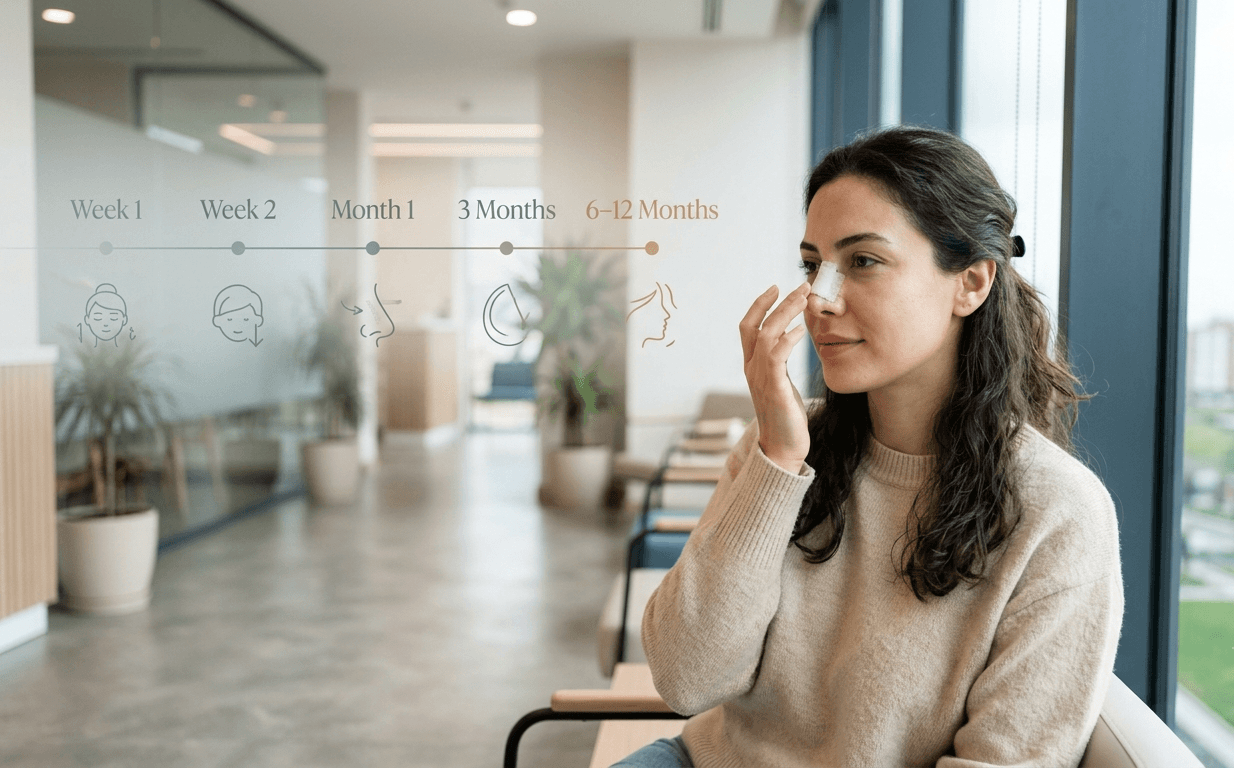
A Turkey nose job is often chosen by international patients who want expert rhinoplasty care, advanced surgical techniques, and a treatment journey that combines aesthetic planning with medical travel convenience. Yet for most patients, the most important part of the experience begins after the operation is over. The quality of recovery has a major impact on comfort, confidence, and the final result. That is why understanding the Turkey nose job recovery timeline week by week is essential before surgery even takes place.
Rhinoplasty recovery is not a single moment but a gradual biological process. The nose changes in layers. Swelling decreases at different speeds in different areas, the skin adapts slowly to the new structure underneath, and the final shape continues to refine long after the first visible healing has passed. Many patients expect the cast to come off and the result to appear almost complete, but advanced rhinoplasty healing does not work that way. A Turkey nose job recovery timeline must be viewed in phases, with each phase bringing its own physical changes and emotional expectations.
For international patients, this understanding is even more important because travel, hotel stay, follow-up planning, and return flights all need to align with realistic healing stages. A patient who knows what to expect after a Turkey nose job is more likely to feel calm, prepared, and satisfied throughout the process.
Why Recovery After a Turkey Nose Job Requires Patience
A Turkey nose job can involve reshaping bone, cartilage, soft tissue, and sometimes internal airway structures. Even when the surgery is performed delicately, the body still responds with inflammation, swelling, bruising, and gradual tissue remodeling. This is normal. The nose is a central facial structure with delicate skin and a limited blood supply in certain areas, which means healing must be respected rather than rushed.
The recovery timeline also varies depending on the type of rhinoplasty performed. A patient undergoing a limited primary rhinoplasty may recover faster than someone having thick skin rhinoplasty, tip refinement, septorhinoplasty, or revision surgery. Skin thickness, cartilage strength, age, healing biology, and post-operative care all influence how quickly swelling settles and how soon the nose begins to show its refined shape.
This is why the phrase week by week matters. Recovery after a Turkey nose job is progressive. What happens in the first few days is very different from what happens during the second month or the sixth month. Each period tells a different part of the healing story.
The First Few Days After a Turkey Nose Job
The first days after a Turkey nose job are usually the most intense in terms of visible swelling, pressure, and general facial discomfort. Most patients do not describe severe pain, but they often experience congestion, heaviness around the nose and eyes, mild drainage, and a sense of tightness. The nose itself may feel blocked because of internal swelling, and breathing through the nose can be difficult at this stage.
Bruising often develops around the eyes, especially if bone work was part of the procedure. Swelling may spread into the cheeks and lower eyelids, creating a tired or puffy appearance. This early phase can be emotionally challenging for patients who are seeing themselves in the mirror and wondering whether the final result will look natural. At this point, however, almost everything is temporary. The nose is still responding to surgery, not yet revealing its outcome.
During these first few days, rest is a major part of recovery. Keeping the head elevated, following medication instructions carefully, staying hydrated, and protecting the nose from accidental contact are all important. A patient recovering from a Turkey nose job should expect to feel socially unpresentable for a short period, but this phase passes much faster than many fear.
The End of the First Week

By the end of the first week, one of the most psychologically important moments usually arrives. This is when the splint or external cast is often removed. Many patients assume this will reveal the final shape of the nose, but that expectation is misleading. What they usually see is a nose that is straighter and more defined than before, yet still clearly swollen, especially through the bridge and tip.
The face often looks significantly better compared with the first few days. Bruising usually begins to fade from dark purple or blue into yellow or green tones, and swelling around the eyes starts to improve. Even so, the nose may appear larger or less refined than expected. This is not a sign of failure. It is one of the most normal parts of the Turkey nose job recovery timeline.
The end of the first week is often when international patients begin preparing to travel home if their surgeon has cleared them. At this point, the patient usually looks well enough for travel, but the nose remains vulnerable. It is essential to avoid pressure, impact, or careless handling during the return journey.
The Second Week of Recovery
The second week after a Turkey nose job is often when patients begin to feel more like themselves again. Bruising usually becomes far less noticeable, and the most dramatic facial swelling continues to decrease. Many people feel comfortable returning to light social activity, remote work, or limited professional routines during this stage.
Although the face may look much better, the nose still holds a substantial amount of swelling. The tip in particular may look stiff, round, or overprojected. Patients with thicker skin often notice that the tip remains especially full, while the bridge may already appear more refined. This uneven healing pattern is entirely normal. Different parts of the nose recover at different speeds, and the lower third of the nose is usually the last area to define itself.
Emotionally, the second week can be surprisingly complicated. The patient no longer looks freshly post-operative, yet the nose is still far from its final appearance. This in-between stage sometimes creates anxiety. Understanding that a Turkey nose job recovery timeline unfolds over months, not days, helps prevent unnecessary worry.
Weeks Three and Four
By the third and fourth weeks, most patients begin to look relatively normal to other people, even though they themselves can still see swelling and subtle irregularities. The nose is often presentable in daily life, but it is not yet stable in shape. Small changes continue from week to week, especially in the front view and in the tip definition.
At this point, internal healing is still very active. Scar tissue is forming and maturing, soft tissue is adapting to the reshaped framework, and the skin is beginning to settle more smoothly over the underlying structure. A patient recovering from a Turkey nose job may notice that the nose looks different in the morning than it does at night, or that swelling fluctuates depending on sleep, diet, heat, stress, or facial movement. This fluctuation is common during the first month.
By the end of the first month, many patients feel encouraged because the nose begins to look more integrated with the face. Yet surgeons know that the majority of healing still lies ahead.
The Second and Third Months
The second and third months of the Turkey nose job recovery timeline are often when refinement becomes more visible. The bridge usually starts to appear smoother and more natural, and the frontal view begins to show better contour. The nose generally looks less swollen to the outside world, which helps patients regain confidence in photos, work settings, and daily interactions.
Even in this stage, however, the tip may remain firm and somewhat swollen, especially in patients with thicker skin or more extensive tip work. This is one of the most important realities to understand after a Turkey nose job. Tip definition is slow. A patient may feel that the bridge looks nearly healed while the lower part of the nose still seems round or less precise. That contrast is not unusual and should not be mistaken for a problem.
Functionally, breathing often continues to improve during this phase as internal swelling decreases. Patients who had septorhinoplasty or structural correction may begin to feel the full benefit more clearly now than in the first month.
Months Four to Six
By months four to six, the nose usually looks significantly more refined than it did in the early post-operative period. Swelling is present but reduced enough that the result begins to resemble the long-term outcome. Facial harmony becomes easier to assess, and many patients finally feel that the nose no longer looks obviously post-surgical.
This part of the Turkey nose job recovery timeline is often where trust in the process becomes rewarding. The tip begins to soften gradually, contour transitions improve, and the nose starts to reflect the surgeon’s intended shaping more accurately. Patients who were anxious early on often feel much more reassured during these months because the nose appears less bulky and more elegant.
Still, healing is not finished. Subtle swelling can remain hidden in the tip, sidewalls, or supratip area. In advanced rhinoplasty, these subtle changes matter. A nose that looks almost complete at four months may still continue to refine quietly over the following half year.
Months Six to Twelve and Beyond
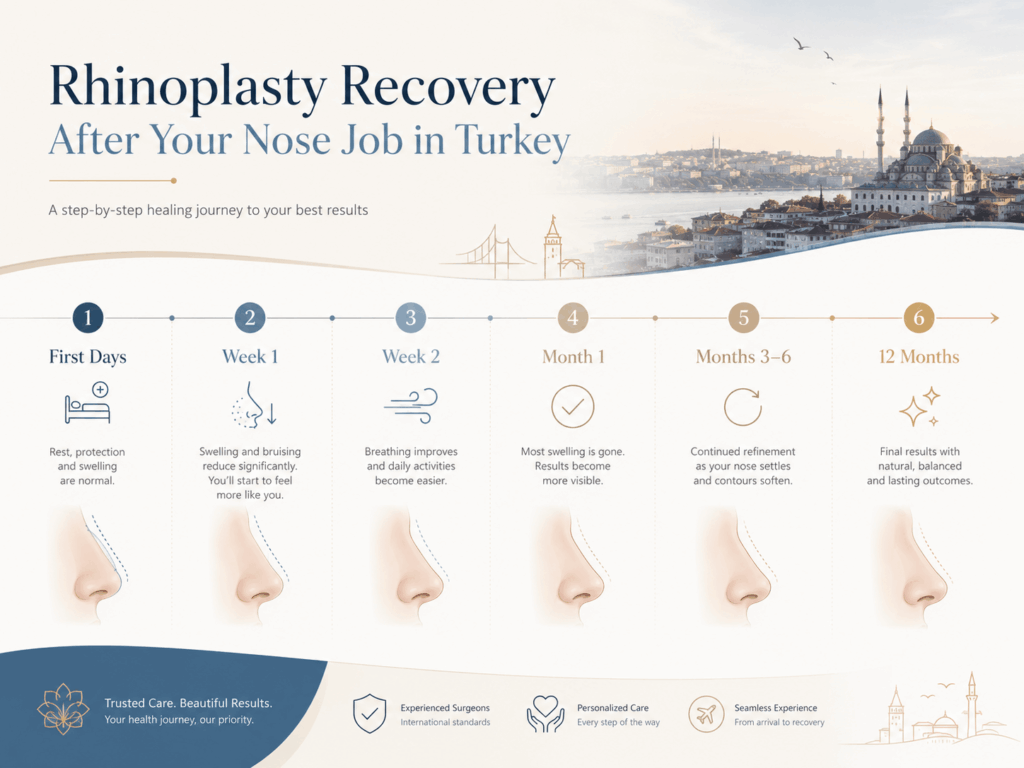
The later phase of Turkey nose job recovery is where the most delicate refinements happen. Between six and twelve months, the nose often becomes more defined, especially in the tip. The skin-soft tissue envelope continues to adapt, scar tissue matures further, and the result gains clarity. This is when patients often notice that the nose feels less stiff and looks more naturally part of the face.
For some patients, especially those with thick skin, revision history, or extensive structural work, healing can continue beyond the one-year mark. This does not mean something is wrong. It simply reflects the biological reality of rhinoplasty recovery. A Turkey nose job is a surgery with a long refinement phase, and advanced patients understand that the final result is earned slowly.
By the end of this period, the nose generally feels more stable in both appearance and touch. The result is no longer defined by swelling but by anatomy.
What Can Affect the Turkey Nose Job Recovery Timeline
Not every patient heals at the same pace after a Turkey nose job. Skin thickness is one of the biggest factors. Thick skin tends to hold swelling longer, especially in the nasal tip, which can delay visible definition. Thin skin may reveal contour changes faster, but it can also show minor irregularities more easily during recovery.
The complexity of surgery matters as well. Primary rhinoplasty often heals faster than revision rhinoplasty. Functional correction, grafting, major tip work, and significant structural changes can all extend the recovery timeline. Lifestyle also plays a role. Smoking, poor sleep, dehydration, inconsistent aftercare, and early trauma to the nose can slow healing or compromise the final result.
This is why recovery should never be compared too rigidly from one patient to another. A Turkey nose job recovery timeline is a guide, not a stopwatch.
Why Realistic Expectations Lead to Better Satisfaction
One of the main reasons patients feel distressed after rhinoplasty is not necessarily poor healing, but poor expectation management. If someone expects the nose to look final after one week, they are likely to be disappointed. If they understand from the beginning that recovery unfolds week by week and month by month, they are more prepared for the emotional rhythm of the process.
A well-informed patient understands that swelling is part of healing, that asymmetry may temporarily appear and disappear, and that refinement takes time. This mindset makes the Turkey nose job journey feel more controlled and less stressful. In advanced aesthetic surgery, realistic expectations are not separate from the result. They are part of the result.
Final Thoughts on the Turkey Nose Job Recovery Timeline Week by Week
A Turkey nose job can deliver highly satisfying aesthetic and functional results, but those results emerge gradually. The first week is about protection and early healing. The second week brings social recovery. The first month shows visible improvement without final definition. The following months gradually reveal shape, balance, and refinement. The final result often takes close to a year, and sometimes longer in more complex cases.
Understanding the Turkey nose job recovery timeline week by week allows patients to approach the process with patience, perspective, and confidence. Recovery is not a passive waiting period. It is an active part of rhinoplasty success. When patients respect that timeline and allow the nose to heal naturally, the outcome is more likely to feel both beautiful and worthwhile.
