






A Turkey nose job can be an excellent option for patients with thick skin, but the answer depends on how well the surgery is planned, how realistic the expectations are, and how experienced the surgeon is in structural rhinoplasty. Thick skin changes both the strategy of rhinoplasty and the pace of healing. It affects tip definition, swelling duration, skin redraping, and the level of refinement that can realistically be achieved. For this reason, patients with thick skin should not approach rhinoplasty in the same way as patients with thin or medium skin. The anatomy requires a different mindset.
This is one of the reasons many international patients begin researching whether a Turkey nose job is a good option for thick skin. They are often looking for surgeons with strong experience in nasal reshaping, especially in cases where the skin-soft tissue envelope is heavier and less revealing. A thick-skinned nose can absolutely be improved, often very significantly, but successful treatment depends less on reducing the nose aggressively and more on creating strong internal support, balanced proportions, and a result that the skin can realistically adapt to over time.
The most important point is that thick skin is not a reason to avoid rhinoplasty. It is simply a factor that must be respected. When the surgery is performed with the right technique and the right expectations, a Turkey nose job can produce natural, attractive, and stable results for thick-skinned patients.
What Thick Skin Means in Rhinoplasty
In rhinoplasty, thick skin does not only refer to how the skin feels to the touch. It describes the weight, density, oiliness, and soft tissue thickness covering the nasal framework. This outer layer influences how much of the underlying cartilage definition will be visible after surgery. In thinner skin, even subtle cartilage shaping may appear clearly. In thick skin, the same refinement may be softened or partially hidden by the skin envelope.
This matters most in the nasal tip. Many patients with thick skin feel that the tip looks round, heavy, wide, or lacking in definition. They may also feel that their nose appears larger from the front, even if the bridge is not especially large. In such cases, the issue is not only the cartilage underneath. It is also the way the skin sits over that cartilage.
A Turkey nose job for thick skin must therefore focus on building a better framework rather than simply removing tissue. If the surgeon reduces too much without maintaining adequate support, the skin may not contract properly around the new shape. This can leave the nose looking undefined, unstable, or even more unnatural during healing. That is why thick skin requires an advanced structural approach rather than an overly reductive one.
Why Thick Skin Changes the Surgical Strategy
Patients with thick skin often assume that the goal of rhinoplasty is to make the nose smaller. In reality, making the nose smaller is not always the best way to create a better result. In thick-skinned patients, excessive reduction can be counterproductive because the skin may not shrink tightly enough to reveal the intended refinement. The result can look blunt rather than elegant.
A well-planned Turkey nose job in thick skin cases usually emphasizes support, shape control, and proportion. Instead of chasing extreme narrowing, the surgeon often focuses on improving the underlying structure so the nose appears more balanced and better defined. This may involve strengthening the tip, refining asymmetries, supporting the bridge, and improving the transition between different parts of the nose.
The key concept is this: thick skin needs a strong frame. If the framework is weak, the skin can dominate the result. If the framework is carefully built, the skin has a better chance of adapting in a pleasing way. This is why experienced rhinoplasty surgeons do not treat thick skin as a minor detail. They treat it as one of the central factors guiding the operation.
Is a Turkey Nose Job a Good Option for Thick Skin Patients
A Turkey nose job can be a very good option for thick skin patients because Turkey has become well known for rhinoplasty and revision rhinoplasty, with many surgeons performing high volumes of nasal surgery and working with a wide range of nasal anatomies. For patients with thick skin, this experience can be especially important. These cases require more than visual taste. They require an understanding of how skin thickness affects healing, tip shaping, and long-term result quality.
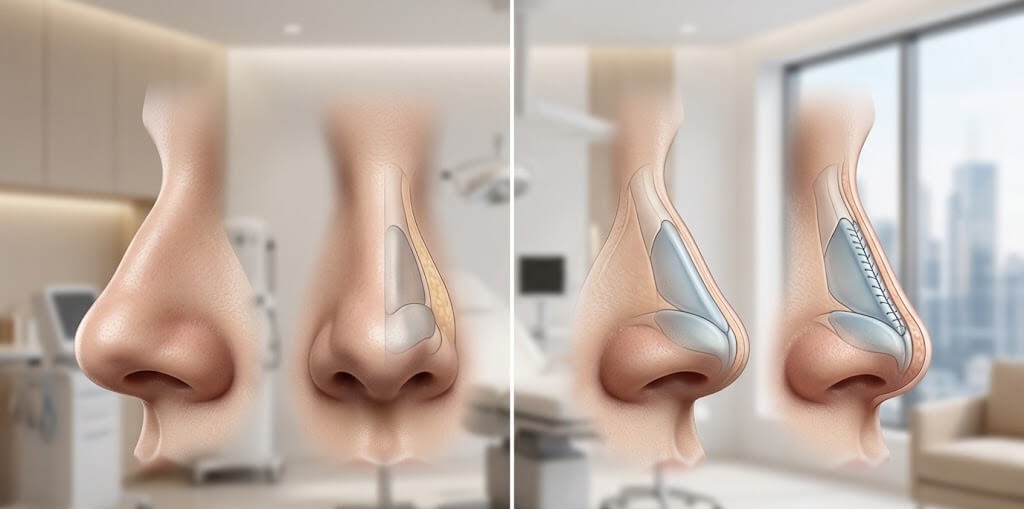
Many international patients are drawn to Turkey because they want a surgeon who is familiar with structural rhinoplasty principles and who can approach thick skin cases with realistic precision rather than generic promises. This can be valuable because thick skin rhinoplasty is often about creating meaningful improvement rather than dramatic instant sharpness. A natural result with better contour, improved harmony, and stronger tip support is often far more successful than an over-promised result that the skin may never fully reveal.
That said, a Turkey nose job is only a good option for thick skin when the patient chooses the right surgeon and understands the true nature of the healing process. The destination alone does not determine the outcome. Expertise does.
What Results Are Realistic in Thick Skin Rhinoplasty
Realistic expectations are essential when deciding whether a Turkey nose job is a good option for thick skin. Thick-skinned patients can often achieve major improvement in profile balance, bridge contour, tip support, and overall facial harmony. The nose can look more refined, more elegant, and more proportional. However, the result may not look as sharply sculpted as it would in a thin-skinned patient.
This is not necessarily a limitation in a negative sense. In many cases, thick skin helps create a softer and more forgiving appearance. Minor irregularities are often less visible, and the final result can look smooth and natural. The trade-off is that very fine contour detail, especially in the tip, may be slower to appear and sometimes less dramatic.
A successful Turkey nose job for thick skin should therefore be judged by harmony, strength, and natural definition rather than by extreme narrowness or overly sharp lines. Patients who understand this usually have a healthier recovery experience because they are not expecting a result that ignores the biology of their skin.
Why Tip Definition Is the Main Challenge
The tip is usually the most difficult area in thick skin rhinoplasty. When the skin is dense and heavy, it can mask the shape of the lower lateral cartilages and limit how much crisp definition becomes visible after surgery. This is why thick-skinned patients often describe the tip as bulbous, rounded, or lacking refinement.
A Turkey nose job can improve this significantly, but the surgeon must usually rely on structural support rather than simple trimming. Advanced tip work often involves strengthening and reshaping the cartilage framework so that the skin rests on a more controlled foundation. This is a more sophisticated strategy than simply reducing cartilage, which can actually weaken the tip and reduce long-term definition.
The tip also heals more slowly than the bridge. Even when the surgery is excellent, thick-skinned patients often experience prolonged tip swelling. In the early months, the tip may look firmer, fuller, or less refined than expected. This does not mean the surgery failed. It means the skin and soft tissue are taking time to settle over the new structure.
Healing Takes Longer in Thick Skin Cases
One of the biggest reasons patients ask whether a Turkey nose job is a good option for thick skin is concern about recovery. This concern is justified because thick skin generally holds swelling longer than thin skin, especially in the nasal tip. The bridge may begin to look refined relatively early, while the lower third of the nose can remain swollen for many months.

This longer healing timeline is one of the most important realities of thick skin rhinoplasty. Patients who expect the nose to look finished soon after cast removal are likely to become frustrated. Thick skin requires patience. The final result often emerges gradually as swelling decreases, scar tissue softens, and the skin adapts to the structural changes beneath it.
A Turkey nose job can still be a strong option in these cases, but only if the patient is prepared emotionally for a slower evolution. The early post-operative appearance is not the final outcome. In thick skin rhinoplasty, time is one of the most important parts of the treatment.
Functional Benefits Still Matter
While many patients focus on appearance, a Turkey nose job for thick skin should also take function seriously. Thick skin does not only affect how the nose looks. It can coexist with structural issues such as weak tip support, septal deviation, internal valve narrowing, or asymmetry. If breathing problems are present, they should be addressed as part of the surgical plan rather than treated as a separate issue.
The best thick skin rhinoplasty is not only about making the nose more attractive. It is also about creating a stable structure that supports both appearance and airflow. A nose that looks smaller but breathes worse is not a true success. This is why experienced surgeons often emphasize structural integrity and long-term support in thick skin cases.
For many patients, this balance is part of what makes a Turkey nose job attractive. They are not just looking for cosmetic reduction. They are looking for an outcome that feels natural, functional, and stable over time.
Why Surgeon Selection Is Especially Important
If you are asking whether a Turkey nose job is a good option for thick skin, the most important question may actually be whether the surgeon has real experience with thick skin noses. This is not a detail that should be overlooked. Thick skin rhinoplasty is one of the clearest examples of why rhinoplasty cannot be approached with a one-size-fits-all method.
An experienced surgeon understands that thick skin requires structural thinking, careful tip support, conservative yet strategic reshaping, and honest communication about healing. They also understand that the best result often comes from respecting the anatomy rather than forcing it into an artificial ideal. A surgeon without this experience may over-reduce the nose, under-support the tip, or create expectations that do not match biological reality.
For this reason, the success of a Turkey nose job in thick skin patients depends less on general popularity and more on case selection, planning, and technical judgment.
Emotional Expectations and Patience
Patients with thick skin often need more patience than they initially expect. This is not because the outcome is worse, but because the timeline is longer and the refinement phase is slower. The nose may look larger than expected in the early weeks, especially after the cast comes off. The tip may seem round or stiff long before it begins to define itself.
This period can be emotionally difficult if the patient has not been prepared for it. That is why realistic counseling matters so much. A good thick skin rhinoplasty journey is often built on trust in the process. Patients who understand from the beginning that definition may arrive gradually are usually better able to stay calm and evaluate their results fairly.
A Turkey nose job is often a good option for thick skin patients precisely because many experienced rhinoplasty surgeons are familiar with this emotional and surgical reality. They know that success in these cases is as much about planning and communication as it is about technique.
Final Thoughts on Whether a Turkey Nose Job Is a Good Option for Thick Skin
A Turkey nose job can absolutely be a good option for thick skin, and in many cases it can be an excellent one. Thick skin does not prevent beautiful rhinoplasty results, but it does require a more advanced strategy, a stronger focus on structure, and more patient healing expectations. The goal is not to force the nose into an unrealistic shape. The goal is to create a balanced, supported, and natural result that the skin can adapt to over time.
Patients with thick skin can often achieve significant improvement in tip support, bridge contour, facial harmony, and overall nasal appearance. The key is choosing a surgeon who understands thick skin anatomy, values long-term structure, and communicates honestly about what can realistically be achieved.
So, is a Turkey nose job a good option for thick skin? In the right hands, with the right expectations, the answer is yes. It can offer meaningful aesthetic improvement, functional stability, and a result that feels refined without looking unnatural. In thick skin rhinoplasty, success comes not from chasing extremes, but from respecting anatomy and building a nose that works beautifully with it.
