






A non surgical nose job Turkey procedure is often presented as a fast, elegant alternative to surgery, and for the right patient, that description can be true. In most cases, the treatment means nonsurgical rhinoplasty performed with dermal filler, usually hyaluronic acid, to temporarily change how the nose looks without cutting, removing tissue, or going through surgical recovery. Cleveland Clinic describes it as a cosmetic procedure that uses dermal fillers to temporarily change the shape of the nose, usually in a single office visit, with results that commonly last about six months.
The key word, however, is temporarily. A non surgical nose job Turkey treatment can improve certain external contour problems very well, but it cannot do everything a true rhinoplasty can do. Cleveland Clinic is explicit that nonsurgical rhinoplasty has limitations: it cannot make the nose smaller, it does not offer permanent change, and it is most appropriate for minor modifications rather than dramatic transformation.
That distinction is where good decision-making begins. The best outcomes happen when patients understand exactly what filler can fix, what it can only camouflage, and what it cannot safely or effectively correct at all. The European guideline on fillers in nonsurgical rhinoplasty makes the same point in more technical language, noting that these nose changes are based on temporary augmentation and that only surgical treatment can provide true reduction or redistribution.
What a Non Surgical Nose Job Turkey Procedure Can Fix
A non surgical nose job Turkey procedure works best when the problem is one of contour rather than size. Because filler adds volume, it can smooth transitions, disguise irregularities, and create the illusion of a straighter, more balanced nose. Cleveland Clinic says nonsurgical rhinoplasty may be right for patients who want to add volume, enhance the nasal tip, smooth lumps or bumps, camouflage a bump on the bridge, or straighten a slightly crooked nose.
This is why the treatment is often effective for a shallow radix, a mild dorsal hump, subtle sidewall irregularities, small asymmetries, and selected post-rhinoplasty imperfections. The European guideline similarly lists indications such as a deep radix, saddle nose, mild hump, some sidewall deformities, mild deviation, asymmetries, improved tip projection or rotation, columellar retraction, a short nose, dorsal augmentation, and contour irregularities after surgical rhinoplasty.
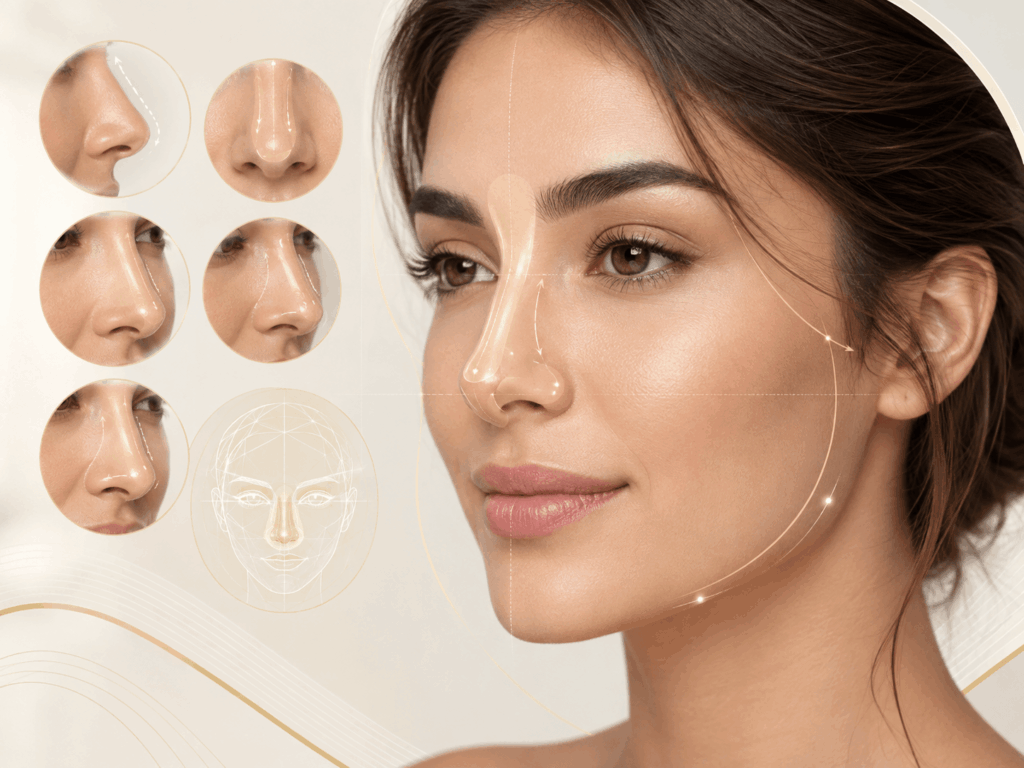
In practical aesthetic terms, this means filler can be very useful when the nose is not truly too large, but visually unbalanced. A small hump can look smoother if surrounding areas are brought into better alignment. A slightly drooping tip may appear more elegant if support is added in the right place. A mild crooked appearance may look straighter when asymmetries are camouflaged rather than surgically rebuilt. In a large ASPS-reported series of 5,000 nonsurgical rhinoplasties, common concerns treated included dorsal humps, drooping tips, lack of definition, frontal asymmetry, and bulbous tips.
This is also why some patients use nonsurgical rhinoplasty as a “bridge” treatment. It can serve people who are not ready for surgery, do not need surgery, or want to preview how certain contour changes might look before deciding on a permanent operation. Cleveland Clinic notes that nonsurgical nose jobs can be an excellent way to make minor changes or find out how certain modifications may look, while the ASPS large-series report describes the treatment as a useful alternative for patients who do not want, cannot have, or do not need surgery.
What It Can Improve Only by Camouflage
One of the most misunderstood parts of a non surgical nose job Turkey procedure is that many of its “corrections” are visual illusions created by strategic augmentation. This is not a weakness of the procedure, but it is an important truth. When filler smooths a hump, it has not removed the hump. When it makes a mildly crooked nose appear straighter, it has not re-broken or repositioned bone. When it improves a low bridge, it has not reconstructed the nose surgically. It has added volume in a controlled way so the overall contour reads as more harmonious. Cleveland Clinic directly explains that filler can temporarily smooth bumps and modify certain characteristics, but it cannot make the nose smaller or narrower.
This is why some patients initially think the procedure “fixed” the nose when what actually happened is that the eye now reads the profile differently. In skilled hands, this can be extremely effective. A nose can look straighter, cleaner, and more refined without surgery. But patients should still understand that the underlying anatomy has not been fundamentally reduced or rebuilt. The European guideline makes this distinction clearly by noting that nonsurgical rhinoplasty is based on temporary augmentation, whereas surgery provides actual reduction or redistribution of tissue and structure.
That camouflage effect is often exactly what makes the treatment attractive. Many people do not need dramatic structural change. They need a profile that photographs better, a bridge that looks smoother, or a tip that appears slightly more lifted. For this kind of patient, a non surgical nose job Turkey procedure can be a very elegant solution precisely because it achieves visible refinement without incisions or downtime. Cleveland Clinic lists immediate results, reversibility, lack of incisions, and no required downtime among the main advantages of the treatment.
What a Non Surgical Nose Job Turkey Procedure Cannot Fix
The clearest limitation is size. A non surgical nose job Turkey procedure cannot make the nose smaller. It cannot truly narrow the nose, reduce nostril width, shave down a large hump, shorten an overly long nose through structural reduction, or create the kind of major size change that surgical rhinoplasty can provide. Cleveland Clinic answers this directly: a nonsurgical nose job can add volume but cannot make the nose smaller, and it cannot narrow the nose.
It is also not the right answer for major deformity. The European filler guideline notes that patients with an upturned or bulbous nose, a severe hump, or significant deviation are not good candidates because expectations are harder to meet. That is an important point. Some nasal problems are too large, too structural, or too three-dimensional to be solved by adding filler on top of them. In those situations, nonsurgical treatment may under-correct the problem, create bulk where the patient actually wants refinement, or simply postpone the more appropriate surgical conversation.
Functional problems are another major boundary. ASPS states that while nonsurgical rhinoplasty can produce beautiful aesthetic improvements, it is not appropriate for functional concerns like a deviated septum. Another ASPS article similarly notes that nonsurgical rhinoplasty works on external issues but cannot correct interior issues such as a deviated septum or nasal function. If the real problem is breathing obstruction, internal valve dysfunction, or septal deviation, filler is generally not the definitive treatment.

There is one advanced nuance worth mentioning. The European guideline notes that, in selected expert hands, nonsurgical rhinoplasty may help some cases of internal nasal collapse and that filler will only work when there is support from an intact septum. It also states that if there is a septal perforation, surgical septorhinoplasty should be offered because filler cannot provide the needed structural support. In other words, filler may play a limited role in very specific functional scenarios, but it should not be marketed as a general solution for breathing problems.
Why Previous Rhinoplasty Changes the Equation
A non surgical nose job Turkey procedure can sometimes help patients who have already had surgery and are left with a small contour irregularity, shallow depression, or subtle asymmetry. This is one of its most useful advanced roles. The European guideline specifically notes that fillers can help address small contour irregularities after surgical rhinoplasty, and Cleveland Clinic also frames the treatment as a way to make modest cosmetic modifications.
But previous rhinoplasty also increases complexity and risk. The filler safety review indexed in PubMed found that patients with previous surgical rhinoplasty had increased odds of adverse events, likely because surgical changes alter nasal anatomy and tissue behavior. ASPS likewise warns patients to be especially careful about liquid rhinoplasty after surgery because altered blood supply raises the risk of vascular compromise.
This means that post-rhinoplasty filler is not automatically a bad idea, but it is not casual treatment either. A tiny post-surgical dent may be a very reasonable use of filler. A major post-surgical deformity usually is not. The more the issue is structural rather than superficial, the more revision rhinoplasty becomes the more appropriate solution.
The Safety Reality Patients Should Not Ignore
One reason patients are drawn to a non surgical nose job Turkey treatment is that it sounds simpler than surgery. Simpler, however, does not mean risk-free. Cleveland Clinic emphasizes that the nose is highly vascular and close to the eyes, making nonsurgical rhinoplasty more technical and complicated than many other filler treatments. It specifically lists vascular complications, tissue necrosis, blurred vision, and vision loss among the serious potential complications.
The European guideline is similarly direct, listing possible early complications such as necrosis, vascular infarction, ocular ischemia, and vision loss, in addition to pain, bruising, bleeding, infection, inappropriate placement, and later displacement or nodularity. ASPS also stresses that nonsurgical rhinoplasty involves a high-risk area and that patients should seek a highly qualified, credentialed injector.
That is also why hyaluronic acid is generally preferred. In the ASPS 5,000-case report, hyaluronic acid was described as the preferred filler because it can be dissolved with hyaluronidase if vascular occlusion occurs. The European guideline likewise describes hyaluronic acid as temporary, reversible, and therefore a suitable first-line option for beginners, while cautioning against permanent fillers such as silicone because of higher rates of difficult-to-manage complications.
Patients should also understand that filler approvals are site-specific. The FDA notes that it reviews and approves different dermal fillers for specific anatomic areas and may not have reviewed certain fillers for all locations in the body. That does not mean every off-label use is automatically improper, but it does mean patients should know exactly what product is being used, why it is being chosen, and how experienced the injector is with that application.
How to Decide Whether It Is the Right Procedure
The best candidate for a non surgical nose job Turkey procedure is usually someone who wants subtle external refinement, understands that filler adds volume rather than subtracting it, and accepts that results are temporary. Cleveland Clinic says the treatment is best suited to minor changes and that those wanting dramatic, long-lasting change are usually better candidates for traditional rhinoplasty. The European guideline adds that good candidates must have realistic expectations and understand that only surgery can truly reduce or redistribute the nose.
This is why the most important question is not whether filler can do something at all, but whether it can do the right thing for the specific problem. If the goal is smoothing, balancing, disguising, or previewing a small change, filler may be excellent. If the goal is major reduction, lasting structural change, or better breathing, surgery is usually the more appropriate route.
Final Thoughts
A non surgical nose job Turkey procedure can fix more than many people think, but less than social media often implies. It can improve a low bridge, camouflage a mild hump, lift or define the tip, soften small asymmetries, and refine selected post-rhinoplasty irregularities. What it cannot truly do is make the nose smaller, narrow it structurally, correct a major deformity, or solve classic internal problems such as a deviated septum. In carefully selected patients, the result can be elegant and highly satisfying, but it works through temporary augmentation and optical balance rather than surgical remodeling.
That is why the real value of a non surgical nose job Turkey treatment lies in precision and honesty. When the indication is right and the injector is highly experienced, it can be a beautiful option. When the indication is wrong, it can create disappointment or expose the patient to risk without solving the real problem. The smartest approach is to treat it neither as a miracle shortcut nor as a minor beauty trend, but as a legitimate medical-aesthetic procedure with clear strengths, clear limits, and a very specific ideal use.
