





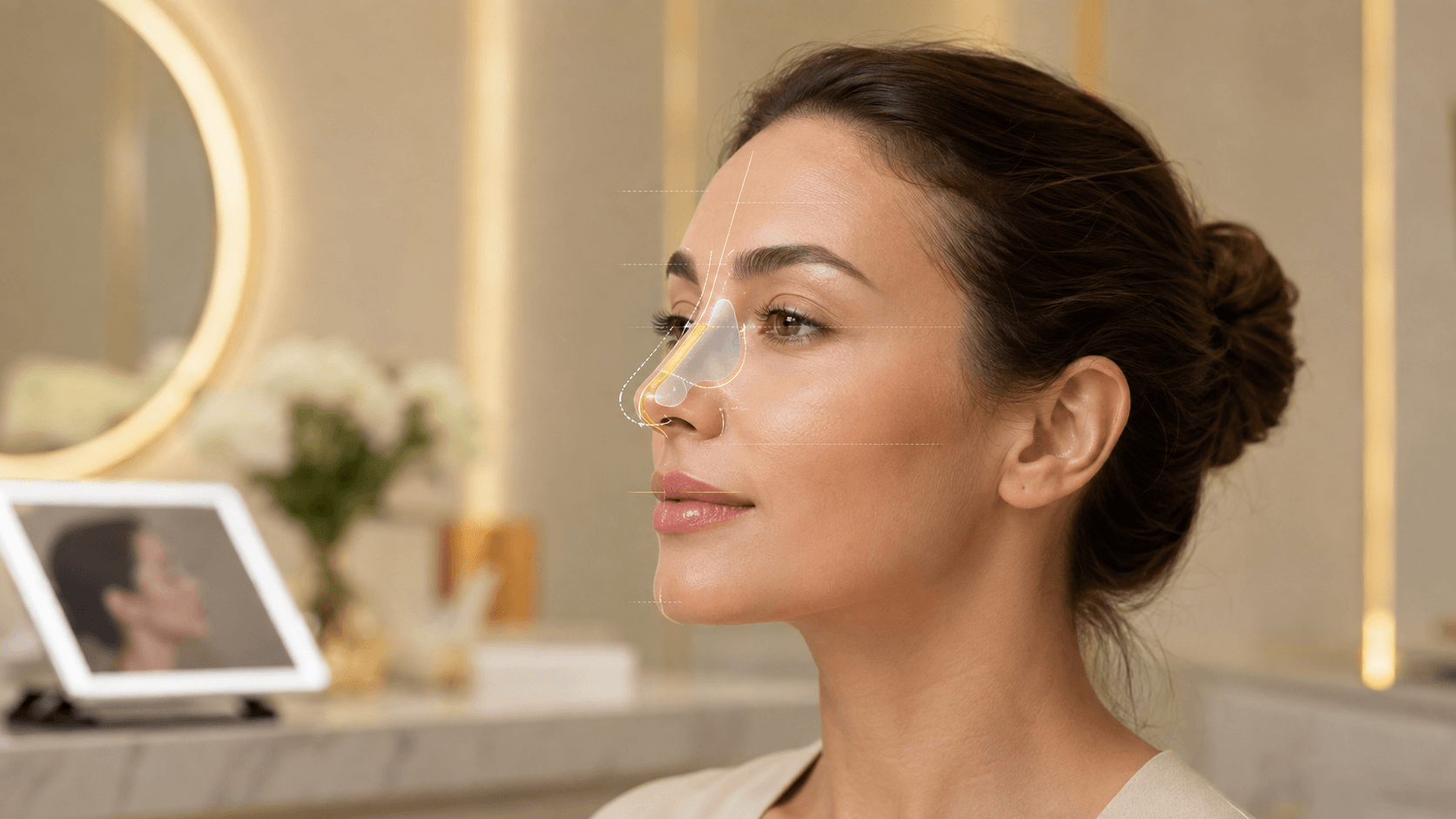
A non surgical nose job Turkey treatment is often considered by patients who want to improve the appearance of the nose without committing to surgery, general anesthesia, or a long recovery period. In most cases, this treatment refers to nonsurgical rhinoplasty performed with dermal filler, usually to smooth contour irregularities, add volume in selected areas, or create the illusion of a straighter and more balanced nasal shape. Cleveland Clinic notes that nonsurgical rhinoplasty can temporarily smooth bumps, enhance the tip, camouflage a hump, and even improve the appearance of a slightly crooked nose, but it cannot make the nose smaller and is best suited to subtle rather than dramatic change.
That distinction is the starting point for understanding candidacy. The best candidates for a non surgical nose job Turkey treatment are not simply people who dislike their nose. They are people whose goals match what filler can realistically achieve. A patient who wants refinement through contouring may be a strong candidate. A patient who wants major structural change, improved breathing, or a smaller nose is usually better suited to surgical rhinoplasty. Cleveland Clinic explicitly states that nonsurgical rhinoplasty may be right for subtle cosmetic enhancement, while patients seeking dramatic or long-lasting changes are generally better candidates for traditional rhinoplasty. ASPS similarly notes that the first step is determining whether a nonsurgical technique can realistically deliver the aesthetic result the patient wants.
Understanding What a Non Surgical Nose Job Can Actually Do
One of the most important parts of patient selection is knowing what the treatment is designed to do. A nonsurgical nose job works by adding filler in carefully chosen areas. That means it improves appearance through camouflage and balance, not through reduction. Cleveland Clinic explains that filler can add volume, enhance the nasal tip, smooth lumps or bumps, camouflage a bridge hump, and straighten a slightly crooked nose visually, but it cannot reduce the size of the nose. In fact, the treatment works by strategically adding volume so the overall shape appears more harmonious.

This is why a good candidate for a non surgical nose job Turkey treatment is often someone with a minor contour concern rather than a major anatomical problem. A shallow bridge depression, a small dorsal hump, subtle post-traumatic irregularity, a slightly droopy tip, or a mild asymmetry can often be improved with filler. ASPS describes one of the most common uses as camouflaging a small dorsal hump by placing filler around it to create a smoother midline bridge. Patients with this type of concern are often much better candidates than those hoping for major reshaping.
The Ideal Candidate Usually Wants a Subtle Change
In practical terms, the ideal candidate is someone looking for refinement rather than reinvention. Patients who do well with a non surgical nose job Turkey treatment usually want the nose to look smoother, straighter, or better balanced rather than radically different. They often prefer a temporary option, appreciate that results are not permanent, and are comfortable with the concept of maintenance. Cleveland Clinic states that results generally last about six months, sometimes somewhat longer depending on the filler used, which means a good candidate is also someone who accepts that repeat treatment may be necessary to maintain the effect.
This treatment can also suit patients who are curious about how certain changes might look before deciding on formal surgery. Cleveland Clinic describes nonsurgical rhinoplasty as an excellent option for people who want to make minor changes or find out how certain modifications may look. That makes it particularly appealing to patients who are not yet ready for a permanent operation but want a preview of aesthetic contour changes.
A Good Candidate Does Not Need Functional Correction
A very important part of candidacy is understanding that nonsurgical rhinoplasty is cosmetic, not functional. ASPS states clearly that nonsurgical rhinoplasty is not appropriate for functional concerns such as a deviated septum. That means a patient who struggles with breathing problems, internal obstruction, valve collapse, or septal deviation is not an ideal candidate if their real goal is functional improvement. In those cases, filler may change appearance temporarily, but it will not solve the structural issue that is affecting airflow.
This is one of the most common reasons patients choose the wrong treatment. They may believe that because a nonsurgical nose job sounds less invasive, it can also be a simpler answer for a nose that both looks and functions poorly. In reality, if breathing is part of the complaint, the patient usually needs a full nasal evaluation rather than a filler-based camouflage approach. A strong candidate for a non surgical nose job Turkey treatment is therefore someone whose concern is aesthetic and minor, not structural and functional.
The Patient Must Have Realistic Expectations
Realistic expectations are central to good candidacy. A nonsurgical nose job can create elegant improvement, but it has built-in limitations. Cleveland Clinic notes that if a patient wants to make the nose smaller or make major structural changes, traditional rhinoplasty is usually the better option. A good candidate understands that filler adds shape and balance rather than removing tissue. They are not expecting a dramatic reduction in bridge size, a major narrowing of the nose, or a permanent transformation.
Patients with the healthiest expectations usually approach treatment with a more precise goal. They may want the bridge to look smoother in profile, the tip to look slightly more lifted, or a mild asymmetry to look softer in photographs. These are the types of concerns that fit the capabilities of nonsurgical rhinoplasty. When expectations stay within that range, satisfaction tends to be much higher. ASPS emphasizes that consultation should focus on whether the technique can realistically achieve the desired result, and that principle is essential in determining who is a good candidate.
Safety Is a Major Part of Candidate Selection
A non surgical nose job Turkey treatment may sound simple because it is performed with injections rather than surgery, but the nose is considered a high-risk area for filler. ASPS warns that nonsurgical rhinoplasty involves filler injection in a high-risk area and stresses that patients should choose a highly qualified, credentialed injector. In a separate ASPS article, Dr. Lee warns that adverse events in this region can include skin necrosis and irreversible blindness. Cleveland Clinic also lists blurred vision among the reasons to contact a healthcare provider immediately after treatment.

Because of that, a good candidate is not only someone with the right nose shape goals. It is also someone willing to prioritize medical safety over convenience, price, or trend. The American Academy of Dermatology advises that filler is a medical procedure and warns against receiving it in non-medical settings such as parties, salons, homes, or non-medical spas. The AAD specifically recommends seeing a doctor with expertise in injecting fillers, because results depend heavily on the experience of the person performing the procedure.
Previous Rhinoplasty Requires Extra Caution
Patients who have already undergone surgical rhinoplasty sometimes consider filler to correct a small residual irregularity. In selected cases this can be done, but ASPS cautions that post-rhinoplasty filler must be approached very carefully because the blood supply to the skin envelope may be altered after surgery, increasing the risk of vascular compromise. That means a previous surgical history does not automatically exclude a patient, but it makes provider selection and case judgment even more important.
For that reason, a post-surgical patient is a good candidate only when the issue is minor, the goals are realistic, and the injector is highly experienced in both surgical and nonsurgical rhinoplasty. A patient hoping to correct a major post-rhinoplasty deformity with filler alone may not be the right candidate at all. In those cases, revision surgery is often the more appropriate conversation.
Who Is Usually Not a Good Candidate
The patients who are not good candidates are often easier to define than the ones who are. Someone who wants the nose to be smaller is usually not a candidate, because filler cannot reduce size. Someone who wants permanent results is generally not an ideal candidate unless they understand the temporary nature of the treatment. Someone with breathing problems, significant deviation, or a major structural complaint is also usually better suited for surgical evaluation. Cleveland Clinic says directly that nonsurgical rhinoplasty does not improve nose function and cannot achieve dramatic structural change.
A poor candidate may also be someone who sees the procedure as casual or risk-free. The treatment may be fast, but the anatomy is not forgiving. ASPS highlights the risk profile of the injection site, and the literature on filler complications includes vascular compromise, skin necrosis, and rare but devastating vision loss when filler enters the wrong vessel. A systematic review of filler-associated blindness identified numerous published cases of vision loss linked to soft-tissue filler injections, underscoring why patient selection and injector expertise matter so much.
The Best Candidate Is Looking for Balance, Not Perfection
The strongest candidates tend to share a similar mindset. They are not chasing an extreme nose. They want better proportion, not a completely different identity. They understand that the treatment can be helpful for small humps, subtle asymmetries, tip enhancement, and contour camouflage. They accept that it is temporary. They do not expect it to solve functional problems. Most importantly, they are willing to have the procedure performed in a proper medical setting by a clinician with deep experience in filler anatomy and nasal aesthetics.
That profile fits the true purpose of a non surgical nose job Turkey treatment. It is best seen as a precision contouring procedure for carefully selected patients, not as a universal replacement for rhinoplasty. In the right person, it can be elegant and effective. In the wrong person, it can lead to disappointment or unnecessary risk.
Final Thoughts
So, who is a good candidate for a non surgical nose job Turkey treatment? The best candidate is someone who wants subtle aesthetic improvement, does not need functional correction, understands that filler adds volume rather than making the nose smaller, and accepts that results are temporary. Minor bridge irregularities, a small hump that can be camouflaged, a slightly droopy tip, or a mild asymmetry are often the kinds of concerns that respond best. Patients who want major reshaping, permanent change, or better breathing are usually better candidates for surgery instead.
Above all, the right candidate is someone who approaches the treatment seriously. Nonsurgical rhinoplasty may be minimally invasive, but it is still a medical procedure performed in a high-risk anatomical area. The safest and most successful results come when candidacy is defined not only by what the patient wants to change, but also by what the treatment can truly and safely achieve.
