






Revision rhinoplasty in Turkey has become a highly searched topic among international patients who are unhappy with the results of a previous nose surgery and want a safer, more refined second procedure. While many people focus on surgeon selection, cost, or travel planning, the most important question often comes much earlier in the decision-making process. The real starting point is timing. Knowing when to undergo revision rhinoplasty in Turkey can make a major difference in surgical safety, technical success, and long-term satisfaction.
Unlike primary rhinoplasty, revision surgery deals with tissue that has already been altered, scarred, and healed in a way that may not be fully predictable. A nose that has undergone one or more previous operations usually needs more careful planning, more nuanced analysis, and more patience before another intervention is considered. For this reason, the best time for revision rhinoplasty in Turkey is not simply when a patient feels disappointed. It is when the nose has healed enough for the anatomy to be assessed accurately and for surgery to be performed under the right biological conditions.
Why timing matters so much in revision rhinoplasty
Revision rhinoplasty is often more complex than a first nose operation because the surgeon is not working with untouched anatomy. Cartilage may have been removed, the skin and soft tissue envelope may be stiff or scarred, and the internal support structures may be weakened. In some patients, breathing issues also develop after the first procedure, which makes the second operation both cosmetic and functional.
This is why timing is not a minor detail. If revision rhinoplasty in Turkey is performed too early, the tissues may still be swollen, distorted, and actively remodeling. That makes it difficult to judge what is a true long-term problem and what is simply part of the healing process. A nose that looks asymmetrical at six months may continue to soften and improve over the following months. A tip that seems too projected or too rounded may still be evolving. Acting too quickly increases the risk of unnecessary intervention or inaccurate corrections.
Waiting long enough allows the surgeon to evaluate the nose in its more stable form. It also gives the tissues time to recover some flexibility, which can improve surgical planning and reduce the chance of compounding the original problem. In revision rhinoplasty, patience is often part of the treatment itself.
The general rule for the best timing
In most cases, the best time for revision rhinoplasty in Turkey is at least twelve months after the previous surgery. This guideline exists for a very important reason. The nose heals slowly, especially after structural reshaping. Swelling can persist far longer than many patients expect, particularly in the tip and in patients with thick skin. Scar tissue also continues to mature for many months after surgery.
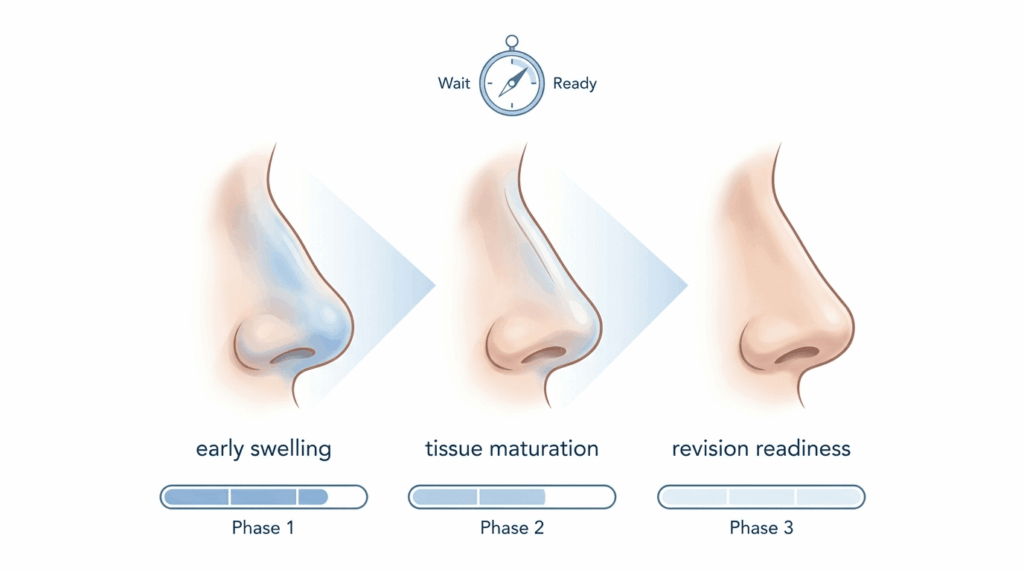
By the one-year mark, most of the visible healing has taken place and the nose is usually stable enough for a meaningful evaluation. The surgeon can identify whether the issue is truly persistent and whether it requires surgical correction. This twelve-month window also helps distinguish between aesthetic dissatisfaction caused by temporary swelling and structural problems that are unlikely to improve on their own.
That said, twelve months is not a rigid rule for every patient. Some cases may require more time, especially after aggressive surgery, multiple previous operations, severe scar formation, or thick skin. In these situations, waiting longer can lead to better tissue quality and a more predictable revision plan. Some surgeons may advise fourteen to eighteen months before revision if the nose is still firm, swollen, or biologically unsettled.
When an earlier revision may be considered
Although waiting is usually preferred, there are exceptions. In selected cases, an earlier corrective procedure may be considered if there is a serious structural issue that is unlikely to improve with time. This may include severe breathing obstruction, major support collapse, obvious deformity caused by trauma, or complications that require timely medical attention. Even then, the approach must be individualized.
It is important to understand that early intervention is not the same as routine revision rhinoplasty. Sometimes a minor corrective step may be performed in the early healing period if a very specific problem is identified. In other situations, however, even a significant cosmetic concern should still wait until the tissues mature. The safest decision depends on the nature of the problem, the condition of the skin and cartilage, and the clinical findings during examination.
This is one of the reasons many patients seek revision rhinoplasty in Turkey with experienced surgeons who regularly handle complex secondary cases. Proper timing is not determined by frustration alone. It is determined by healing biology, anatomy, and the feasibility of correction.
Signs that you may still be healing rather than needing revision
Many patients begin researching revision rhinoplasty in Turkey before their first result has fully settled. This is understandable, especially if they feel anxious or disappointed after the initial surgery. However, certain post-operative changes are still part of normal healing and should not automatically be treated as final.
Persistent swelling is one of the most common reasons patients think they need revision too soon. The nasal tip may look bulky, hard, undefined, or asymmetrical during the healing phase. Skin thickness can make this process even slower. Scar tissue may create temporary irregularities that soften over time. Small asymmetries, shifting edema, and fluctuating definition are also common during recovery.

If the overall nasal framework is intact and there is no urgent functional problem, it is often better to continue observing the nose rather than planning a second operation immediately. An experienced revision surgeon will usually assess not only what is visible, but also whether the observed issue is mature enough to justify surgery.
Signs that revision may truly be necessary
The right time for revision rhinoplasty in Turkey often becomes clearer when certain problems remain stable over time and do not improve with healing. These may include persistent deviation, collapse of the nasal bridge, pinching in the middle vault, significant tip asymmetry, over-resection that creates an unnatural look, or ongoing breathing difficulty caused by structural compromise.
In some patients, the main concern is not obvious to others but still important. The nose may feel too operated, too narrow, too short, or disconnected from the rest of the face. In revision cases, both aesthetics and function matter deeply. A successful second surgery is not simply about making the nose smaller or smoother. It is about restoring balance, support, and a natural appearance while preserving or improving airflow.
When these concerns remain unchanged after adequate healing, a consultation for revision rhinoplasty in Turkey becomes more appropriate. The surgeon can then assess what is surgically possible and whether the timing is ideal for a safer intervention.
Why tissue condition matters as much as the calendar
Even though one year is the standard guideline, calendar time alone does not decide readiness for revision. The condition of the tissue is equally important. Some noses look healed externally but remain firm, stiff, or scarred internally. Others recover more gently and become suitable for revision at the expected time. A proper examination is necessary to determine whether the skin envelope is mobile enough, whether scar tissue is excessive, and whether grafting may be needed.
Revision rhinoplasty often requires cartilage grafts to rebuild support or refine shape. Depending on the previous surgery, septal cartilage may no longer be available, which means ear or rib cartilage may need to be considered. This is another reason why revision surgery must be approached with long-term planning rather than impatience. The best outcomes come from working with tissues that are mature enough to tolerate precise reconstruction.
Is Turkey a good place to wait and plan revision surgery carefully
For many international patients, revision rhinoplasty in Turkey is attractive because of the combination of surgeon experience, advanced aesthetic practice, and the opportunity to receive treatment in a well-established medical travel setting. However, the best results still come from appropriate planning rather than rushing into surgery because travel arrangements feel convenient.
A thoughtful surgeon will not encourage a premature revision just because the patient is eager to move forward. On the contrary, one sign of high-level expertise is the willingness to delay surgery when the nose is not ready. Patients should look for a specialist who carefully reviews previous surgical history, studies the healing timeline, assesses breathing and structural support, and explains what can realistically be improved.
In this sense, the best time for revision rhinoplasty in Turkey is not only a matter of months after the first procedure. It is also the moment when the patient has enough information, realistic expectations, and access to a surgeon who understands the limitations and possibilities of secondary rhinoplasty.

Emotional readiness is also part of good timing
Patients seeking revision rhinoplasty are often dealing with disappointment, insecurity, or a loss of trust after an unsatisfactory first operation. These emotional factors are real and should not be dismissed. However, emotional urgency can sometimes push patients toward decisions that are too fast. Wanting a quick fix is understandable, but revision rhinoplasty rarely rewards haste.
Good timing also means psychological readiness. Patients benefit from entering revision surgery with a clear understanding of what bothers them, what can be corrected, and what surgical limitations still exist. The goal should not be perfection. It should be meaningful improvement, better harmony, and a more stable outcome. The more realistic the expectations, the healthier the revision journey tends to be.
What happens during a revision consultation
When considering revision rhinoplasty in Turkey, a proper consultation should go beyond simple before-and-after discussion. The surgeon should evaluate prior surgical history, visible asymmetries, skin thickness, internal valve function, scar tissue, tip support, and facial proportions. In many cases, breathing concerns and aesthetic concerns overlap, and both should be addressed together.
The timing question is central to this consultation. A skilled revision surgeon will tell you whether your nose has healed enough, whether your concerns are likely to improve further without surgery, and whether your anatomy is suitable for intervention at this stage. If the answer is to wait, that advice should be seen as a sign of responsibility, not hesitation.
Final thoughts on the best time for revision rhinoplasty in Turkey
The best time for revision rhinoplasty in Turkey is usually at least twelve months after the previous nose surgery, but the ideal timing depends on more than the calendar. It depends on tissue healing, scar maturity, structural stability, breathing function, and the persistence of the concern over time. In more complex cases, waiting longer may lead to a safer and more precise outcome.
Patients who are considering revision should resist the pressure to act too early, even if they are unhappy with the current appearance of the nose. Healing after rhinoplasty can be slow, and what looks wrong in the middle of recovery is not always wrong in the final result. At the same time, truly persistent structural or functional issues should not be ignored once healing is complete.
Revision rhinoplasty in Turkey can offer an excellent opportunity for patients who need a second chance at both form and function. The key is choosing the right surgeon and choosing the right moment. In revision surgery, timing is not just part of the process. It is one of the foundations of success.
